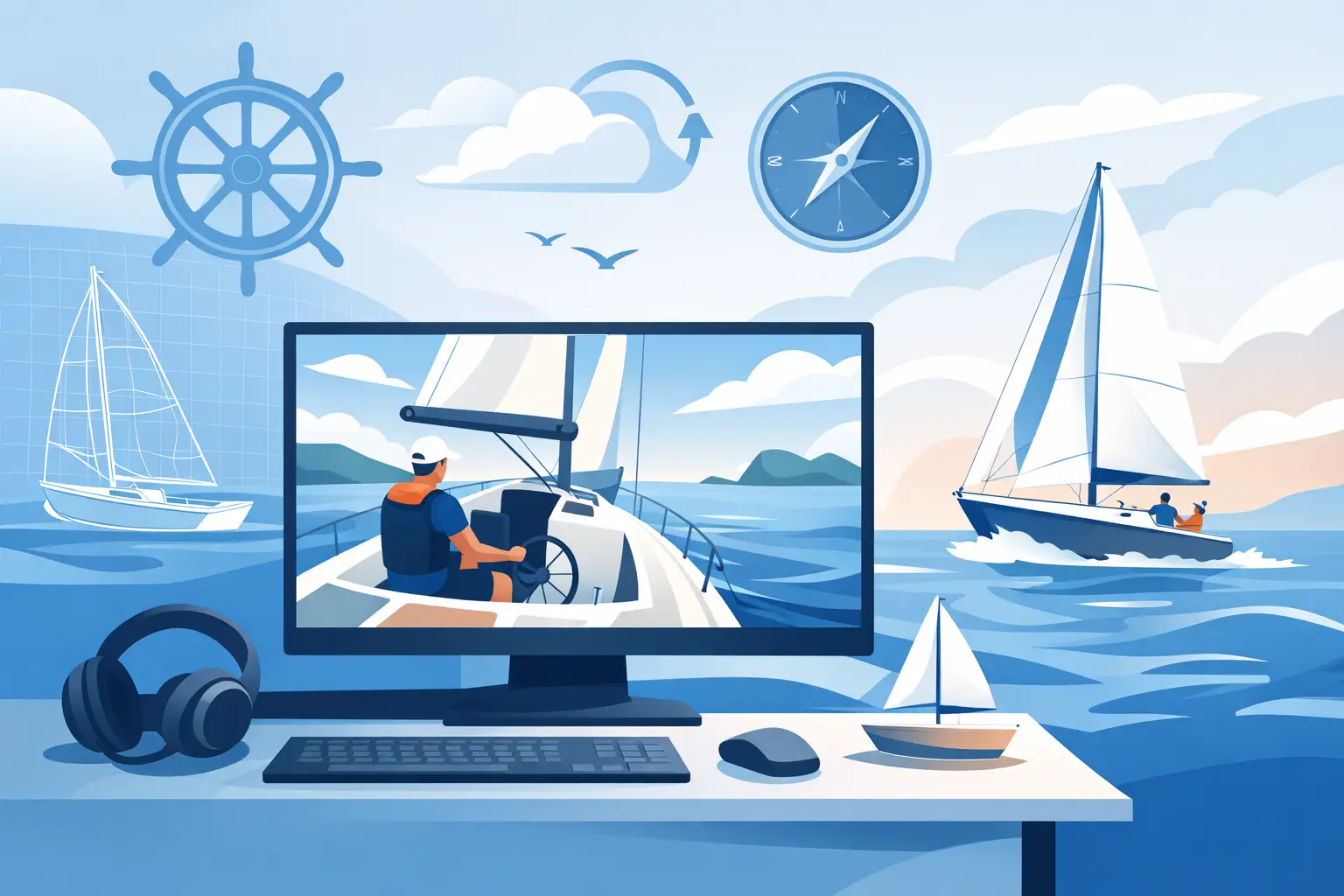
The best sailing simulator isn’t just one that shows a pretty boat on the screen. It needs to make you feel the consequences of every choice: if you point too close to the wind, the boat loses speed; if you ease the sail at the right moment, you gain speed; if a gust hits, you have to react. It’s in this direct relationship between action and result that sailing stops feeling like a collection of difficult terms and starts to make sense.
For those who want to get into the sport, the simulator breaks down a huge barrier. It doesn’t require a boat, a club, a life jacket, a trailer, or a whole free afternoon. For those who already sail, it provides a way to practice maneuvers, test courses, and compete in regattas when you can’t make it to Guaíba, the reservoir, or the ocean. But not every digital experience truly teaches you anything. It’s worth knowing what to look for before choosing where to chase virtual wind.
What makes a sailing simulator really good?
A sailboat works because the boat finds a balance while moving. The wind hits the sails, generates fclose-hauled, the hull responds, the rudder corrects the course, and the sailor decides the next heading. If a game reduces all of this to a single “accelerate” button, it might be fun, but it doesn’t prepare you to understand what happens on board.
A good simulator puts the wind at the center of the experience. You need to see where it’s coming from, notice changes in its intensity, and adjust the boat’s course according to the sailing area. Sailing upwind requires point up without overdoing it. Sailing broad reach usually provides speed. Sailing downwind requires a different trim and careful attention to keep the boat under control.
The sail also needs to respond to the trim. The mainsail and the genoa can’t just serve a decorative purpose. Trimming brings the sail closer to the center of the boat and usually helps when you want to gain height. Easing the sheet opens the sail to catch the wind on broader courses. There is no single perfect setting for every situation: it depends on the course, wind strength, gusts, and the objective of that leg of the race.
Another key factor is the apparent wind. As the boat picks up speed, the wind it feels changes in direction and strength relative to the true wind. It seems like a technical detail until you realize, in practice, that even a small change in course may require a new adjustment to the sails. A useful simulator doesn’t need to display formulas on the screen, but it should make this effect clear in the sailboat’s behavior.
Nautical Physics: Where Learning Takes Place
Physics is what distinguishes a seaworthy model from an exercise that builds your repertoire. The rudder needs to be responsive, but it can’t become a magic lever. A sharp turn reduces speed, alters the boat’s balance, and may require you to regain the flow in the sails. The boat should heel when pressure is applied, and that heel must indicate something concrete: the fclose-hauled is working, but maybe you’re pushing it too far.
Gusts and shifts also make a difference. When the wind is too steady, anyone can learn a set sequence and stop paying attention. A gust, on the other hand, calls for quick decisions. You can adjust the helm, ease off the sail, slightly change course, or combine these actions. The choice depends on the situation. Over a short stretch, maintaining speed may be more important; near a mark, positioning the boat for the next maneuver may be the priority.
That’s why repeating the same situation over and over is so valuable. You get into a lane, try a close-hauled, miss the turning point, lose ground, and start over. On the second try, you adjust your timing earlier. On the third, you realize you were trying too hard to match the instructor. This cycle doesn’t replace the physical sensation of being in a real boat, with water, waves, and a crew, but it creates a much more useful foundation than memorizing isolated definitions.
First, get a feel for the boat. Then, look up the term.
Beginners don't need to memorize a nautical dictionary before setting sail. Start by paying attention to three things: the wind direction, the pressure on the sails, and the boat's speed. Take to the virtual water, point the sailboat in different directions, and see when it speeds up or slows down.
Next, match what you saw with the terms. Turning the bow into the wind is a windward turn. Turning the stern into the wind is a broad reach. point up is climb up against the wind within the range where the candles are still active. The terms become easier to understand once they correspond to an action you've taken.
The best sailing simulator for regatta training
Learning to sail a boat is only part of the story. The other part is making decisions against the clock and against other sailors. A regatta involves the pressure of the start, choosing a tack, approaching a mark, and reading the wind. It’s not enough to just go fast in a straight line, because the shortest route is almost never navigable.
Training against bots is a good start. You can see how your start affects the rest of the race without having to coordinate a time with anyone. If you got off to a slow start, you need to find some clean air. If you chose the wrong side, you might have to cross the lane where there’s less pressure. The stopwatch adds objectivity to your training: it wasn’t just a feeling that the boat performed better—it was a measurable difference.
The live multiplayer It adds the social aspect that makes so many people fall in love with sailing. When friends are on the same course, every crossing becomes a question: who has the right of way, who’s in the better position, who’s going to take a chance on a maneuver? Sharing a link and scheduling a rematch makes the regatta accessible even to those who live far from an active fleet.
Still, competition isn’t synonymous with chaos. The best experience allows you to understand why you lost time. Was it a poorly trimmed sail? A tack taken too early? A bad decision near the mark? Without that insight, the result seems random. With it, every race becomes a learning experience for the next one.
Easy access changes who can sail
Sailing has an image of being an exclusive sport because, often, a person’s first experience with it depends on equipment, travel, and an invitation. A simulator free in your browser Change that starting point. Whether on your phone, tablet, or computer, you can try it out before deciding whether to look for a school, join a club, or chat with sailors in your city.
Not installing anything is also important. If curiosity strikes within a ten-minute window, the best thing to do is open the screen and get started. This immediate access encourages learning by trial and error: adjust the sails, mess up a maneuver, try again. With no mandatory registration, no ads interrupting your session, and no in-app purchases locking out basic features, your attention stays where it should be—on the wind and the boat.
This is the concept behind VelejAÍ: transforming concepts such as apparent wind, heel, mainsail, genoa, and rudder response into visible outcomes while sailing. The platform doesn’t promise that a screen will replicate every aspect of a real sailing trip. It offers something very concrete: a place to develop wind reading skills, coordination, and strategy before your next time on the water.
How to Evaluate Before Making a Choice
When testing a simulator, perform a simple check. Sail in various directions and see if the speed changes consistently. Adjust the mainsail and the genoa separately. Force a turn and see if the boat loses momentum. Look for gusts or wind shifts. Finally, enter a regatta and see if strategy matters as much as quickly pressing the controls.
If the experience is just about accelerating and heading for the next buoy, it’s more of a pastime. If it forces you to read the wind, choose the tack, and trim the sails for each course, then it’s a learning tool. The ideal level of realism depends on your goal: beginners need clarity; those who already compete will seek greater tactical depth.
The best choice is the one that makes you want to come back for another try. Start with a short run, observe the effect of each adjustment, and when you nail a good start, ask someone to race you on the next one. The wind won’t wait, and the next gust might be exactly the lesson you needed.