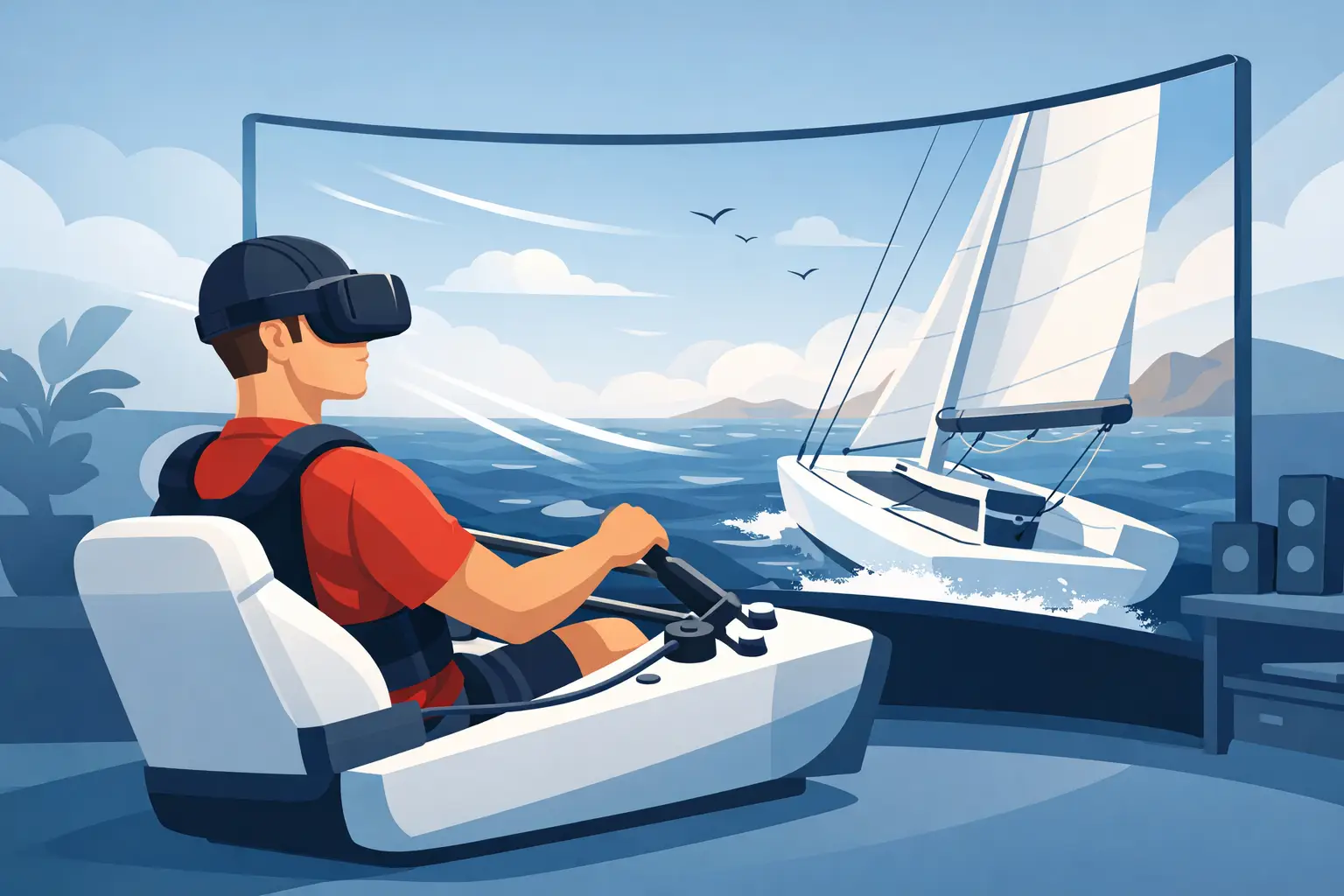
The gust hit the stern, the hull heeled over, and the boat began to drift off course. You can correct the course with the helm, ease off the mainsheet a little, or let the pressure build for a few seconds to gain speed. It’s this decision—made while the wind is shifting—that makes a sailing simulator to go beyond being just a game and become a real way to understand sailing.
For anyone who’s always wanted to get on a boat, obstacles often arise before the very first outing: a club, equipment, lessons, time, travel, and the fear of not even knowing where to start. On the screen, that distance shrinks. You open the browser, take the helm, adjust the sails, and immediately see how each choice affects the sailboat. Take the plunge into the virtual waters and turn your curiosity into sailing skills.
What a sailing simulator teaches in practice
Sailing isn’t just about pointing the boat in the direction you want to go and accelerating. The sail performs based on the angle of the wind, the chosen course, and the trim available at that moment. If you trim the sail too tight on a broad reach, it loses efficiency. If you let it out too much on a close-hauled, the sail stops working. The boat responds, loses speed, and shows that theory has real-world consequences.
In a good simulator, this learning process is a cause-and-effect relationship. Change course and observe the apparent wind Change the direction of the sails. Pull on the sheet and feel the boat gain speed or heel over more. Let go at the right moment, and it’ll breathe again. You don’t need to memorize all the terms before you start: first you try it out, then the names will make sense.
The difference lies in the physics. A realistic sailboat doesn’t turn like a car, doesn’t maintain the same speed on all courses, and doesn’t ignore a gust. The tiller provides a gradual response, the hull heels under pressure, the sails require trimming, and the wind doesn’t behave the same way when the boat is at a standstill or moving along. Understanding this is at the heart of sailing.
True wind, apparent wind, and quick decisions
True wind is the wind that blows over the water. Apparent wind, on the other hand, is what you feel on board after adding the true wind to the boat’s motion. It may seem like a minor detail, but it explains why a sail that was properly trimmed may need adjustment immediately after a burst of speed or a change in course.
Imagine you’re on a close-hauled, sailing upwind as close as possible. As you pick up speed, the apparent wind tends to shift further ahead. You may need to trim the sail slightly to keep it working effectively. If you bear away to a broader course, the wind comes from a different direction and requires you to trim the sail further. A sailing simulator lets you repeat this cycle as many times as needed, without having to wait for your next sailing trip.
Gusts add another layer of complexity. They can increase speed, but they also increase heel and the load on the rudder. Sometimes it’s worth trimming up slightly to relieve the sail. Other times, easing the mainsheet helps maintain the course and keeps the hull more balanced. The best response depends on the intensity of the gust, the course, and your position in a race. Sailing is about adjustment, not a fixed formula.
Start by learning to control the boat, not by striving for perfection
The primary goal isn’t to win a race. It’s to understand how the boat responds to your commands. Choose a free practice session, let the wind in, make small adjustments to the helm, and observe how the hull reacts. Abrupt changes usually cost you speed and can throw off your course. Small, early corrections tend to work best.
Next, practice your course. Sail on a beam reach—when the wind is coming roughly from the side—and notice how easily the boat picks up speed. Try it close-hauled and find the point where aiming higher starts to slow you down. Do a tacking maneuver and watch the sail ask for another opening. When each course stops being an arrow on a compass and becomes a sensation of pressure and performance, the learning clicks into place.
A master adjustment And the genoa deserves attention from the very beginning. The mainsail directly influences the boat’s balance and main power. The genoa helps build speed, especially on tighter courses. Instead of adjusting both sails haphazardly, change one at a time and compare the results. You learn more by observing a clear reaction than by making five adjustments at once.
Maneuvers That Change the Way You View a Regatta
A tack occurs when the bow passes through the wind. It’s an essential maneuver for zigzagging upwind, choosing tacks that lead to the next buoy. Enter the tack with speed, steer the boat decisively, and let the sails cross at the right moment. A slow jibe, with poorly positioned sails, can cost you valuable meters.
A jibe occurs when the stern passes through the wind, usually on downwind courses. It requires caution because the boat changes sides very quickly. In a simulation, it’s worth testing what happens if you turn too quickly, leave the sail too close to the wind, or lose control after the transition. Making mistakes on the simulator is useful precisely because it shows why the maneuver requires preparation on the water.
It’s also worth practicing buoy approaches. Approaching too fast may force you to take a wide turn. Approaching without enough speed can leave the boat vulnerable to competitors coming from the outside. In a race, it’s not enough to simply find the theoretically shortest course. You need to protect your space, choose the most favorable side of the course, and keep the boat moving.
Solo training or a competition with friends?
The two formats serve different purposes. During individual training, you can mentally pause the rush and repeat the same situation: a start, a sequence of turns, a stern approach. It’s the place to test adjustments and understand why the boat lost performance.
When it comes to avoiding bots, time pressure and traffic come into play. You begin to realize that sailing well involves looking ahead, not just at your own sail. A route that seems good may be blocked by another boat or require an extra maneuver.
In live multiplayer, the strategy comes to life. A tight start, choosing a side of the course, and a rematch after losing by just a few seconds create a competition that teaches without feeling like a lesson. Share the link, call your crew, and race. The strategy gets more interesting when someone threatens to steal the lead at the next buoy.
What Simulation Solves and What It Cannot Replace
A simulator eliminates costs and logistical challenges, but it does not completely replace the physical experience on board. On the water, you feel the waves, the motion, the noise, the cold, the splashes, and the direct pull of a loaded sheet. You also learn safety procedures, crew communication, and boat maintenance that are specific to the real-world environment.
Even so, the simulation can lay the groundwork very well. It helps you arrive at an in-person class understanding that you don’t sail directly into the wind, that the sail needs to be at the right angle, and that every maneuver affects balance, course, and speed. For those who already sail, it becomes a convenient way to keep your skills sharp between outings.
On VelejAÍ, this happens right in your browser—no installation, no mandatory registration, no ads, and no in-app purchases. It works on cell phones, tablets, and computers, allowing you to squeeze in a short session during a break in your day or practice an entire sequence of maneuvers before the weekend at Guaíba.
How to Improve with Each Session
Start with a simple question instead of trying to control everything. Today, try to figure out what close-hauled’s sweet spot is. In the next session, observe how a gust changes the heel angle. Then, perform ten tacks while trying to lose as little speed as possible. This focus turns minutes of sailing into deliberate practice.
Once you feel more confident, use the stopwatch as a reference, but not as your only measure. Winning a race is great. Understanding why you lost speed coming off a buoy is even more valuable, because that insight will stay with you at the next start.
Sailing rewards those who pay attention. Trim the sails, keep track of the apparent wind, and give the boat room to respond. Every mistake you make safely on the simulator can lead to a calmer decision when the wind is actually blowing.