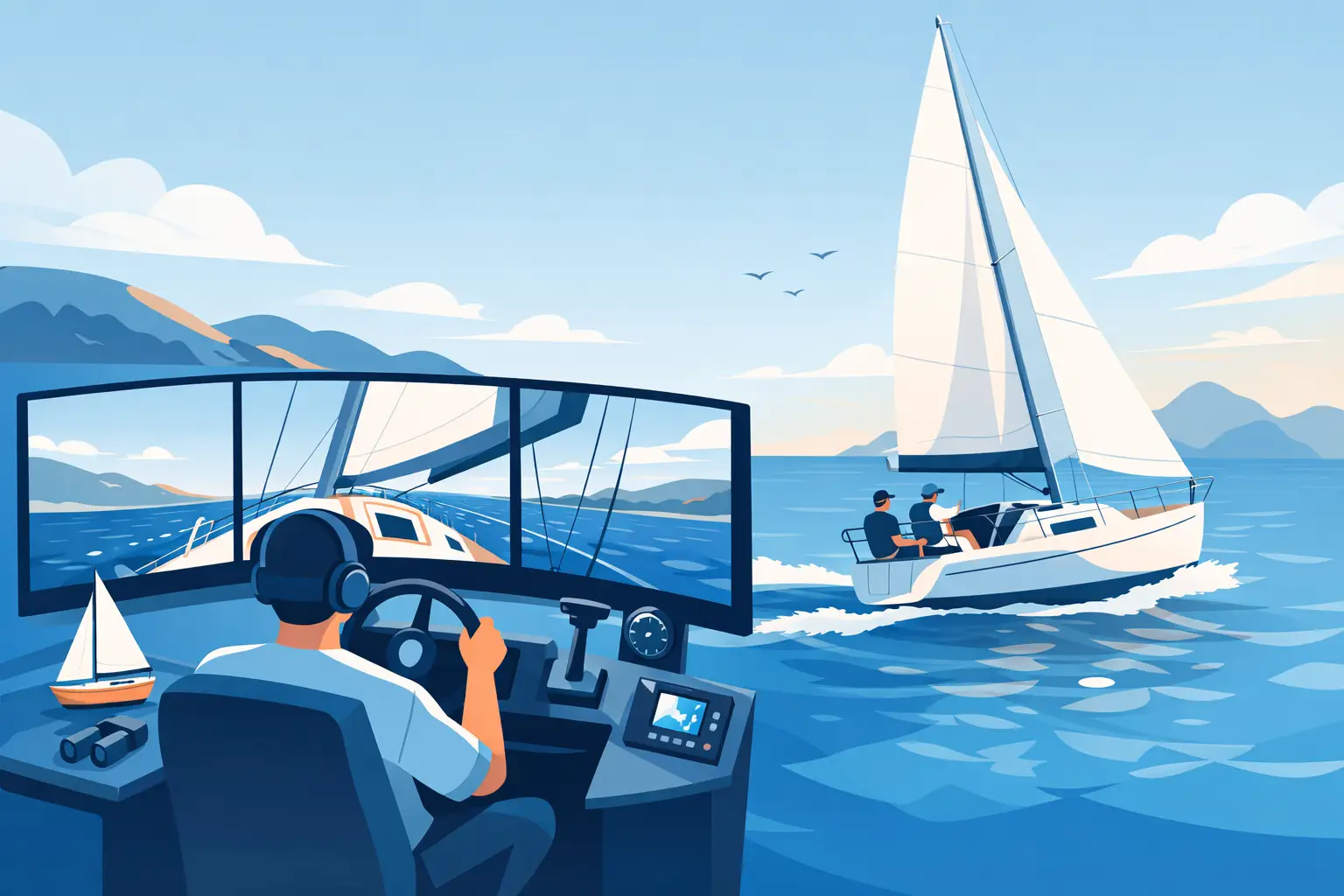
You don't learn to sail by memorizing the names of the parts. You learn when you point the bow into the wind, feel the boat lose fclose-hauled, trim the sail at the right moment, and realize that a gust can change everything. For those looking for the best simulator for learning to sail, the point isn't just to have a pretty boat on the screen: it's to be able to test decisions and see their consequences.
A good simulator needs to bring the logic of sailing to life. You change course, adjust the mainsail and genoa, correct the helm, and understand, in practice, why the boat accelerates, heels over, or comes to a near standstill. It’s this cycle of trial, error, and adjustment that builds your repertoire before your first time out on the water.
How does a simulator teach real sailing?
Sailing happens at the intersection of the boat, the wind, and the helm. If a simulator oversimplifies this relationship, it may be fun, but it doesn’t teach much beyond pressing a button to go faster. A useful learning experience, on the other hand, makes it clear that every choice comes at a cost: gaining height can cost you speed; letting the sail hang too loose wastes wind; and tacking without preparing for the maneuver can throw the boat off its rhythm.
The best simulator for learning to sail doesn’t take the challenge out of navigation. It presents that challenge in an accessible way. Instead of starting with a list of technical terms, it puts you at the helm and lets physics explain it all. The sail needs to be at the right angle to the wind. The rudder changes course, but it can also slow you down if overused. The Aderna hull because the fclose-hauled wind is blowing against the sails.
This visual feedback is essential for beginners. When the boat responds consistently, the sailor stops making random movements and begins to ask better questions: Why did I lose speed? Why can’t I point higher? When should I trim the genoa? The answer lies in the boat’s behavior, not in a single, isolated setting.
Start without a club, a boat, or expensive equipment
Getting out on the water in person is a special experience, but it requires coordinating your schedule, access to a club, an instructor, a boat, a life jacket, favorable weather conditions, and transportation. For many people, this gateway remains out of reach. A browser-based simulator reduces these barriers: just open it on your phone, tablet, or computer and start sailing.
Free access and immediate availability aren’t just minor details. They let you practice for fifteen minutes between appointments, repeat a maneuver ten times without feeling self-conscious, and come back the next day with a specific question. You don’t have to wait for a class to try out what happens when you bear away, luff up, or ride through a gust.
VelejAÍ follows exactly this logic: a free 3D simulation with no installation, no mandatory registration, no ads, and no in-app purchases. The goal isn’t to replace the sensation of spray on your face, the weight of the sheet, or reading the sky on a lake or at sea. It’s to train your eye and your decision-making so that, when the time comes to get into a real boat, apparent wind, course, and trim no longer seem like a foreign language.
Learn through cause and effect
First, find that fclose-hauled wind
The wind doesn't always push the sailboat in the same way. On certain courses, it fills the sails better and the boat really comes to life. On others, you need to trim the sails carefully so as not to let the boat lose pressure. When sailing, pay attention to the relationship between the wind direction and the boat’s course before trying to pick up speed at any cost.
That’s the first lesson a realistic simulation teaches: there’s no single “correct” setting. The position of the sails changes depending on the course. If you change direction and keep everything else the same, the boat responds. Sometimes it slows down. Sometimes it picks up speed. Sometimes it starts to heel more than it should. This understanding is the foundation of any sailing trip.
Next, adjust the mainsail and genoa
The mainsail and the genoa are wind-powered sails, but they don’t operate automatically. Trimming brings the sail closer to the boat’s centerline; easing it out increases the angle of the sail. The ideal adjustment depends on the wind and the course. When the sail is at the right angle, it works effectively. When it’s at the wrong angle, the boat drifts, loses speed, or becomes difficult to steer.
In the simulator, it’s worth doing a simple exercise. Sail on a steady course and adjust only one sail at a time. See how the boat’s speed, heel, and response change. Then do the opposite: keep the sails the same and adjust the course. In just a few minutes, you’ll understand why experienced sailors are constantly adjusting their sheets instead of leaving them fixed.
Steer the boat without fighting it
Beginners tend to turn the helm too much. It’s a natural reaction, especially when the boat heels or seems to be getting out of control. But turning the helm too much creates drag and slows you down. The most effective correction is usually a smaller, early adjustment, accompanied by sail trim.
Simulation helps because it lets you reenact the situation without any risk. Sail into a squall, feel the hull heel, and try to stay on course with smooth movements. Then repeat the process, overreacting with the helm. You’ll see the difference right away. You’ll realize that good steering isn’t about making more fclose-hauled, but rather making the right adjustment before the boat starts to struggle.
Gusts and apparent wind: where sailing gets interesting
A steady wind is great for learning the basics. But the boat really starts to “talk” to the sailor when gusts and shifts set in. A gust increases the pressure on the sails, changes the heel, and may require a course correction or an adjustment to the sheet. A shift changes the direction of the wind and calls for a quick assessment.
There is also the apparent wind, which is the wind that the sailor feels on board. It results from the combination of the actual wind and the boat’s own movement. As you pick up speed, this perceived wind can change in intensity and direction. It seems advanced at first, but it becomes intuitive once you see the effect on the sail and the boat’s performance.
That’s why a good simulation shouldn’t treat the wind as mere window dressing. It needs to be part of the race. If you time your move right, the boat surges ahead. If you ignore a shift in pressure, you lose ground. This kind of response makes the training useful both for those who have never sailed and for those who want to keep their skills sharp away from the race course.
Regatta Turns Practice Into a Decisive Match
Training alone teaches self-control. Competing in a regatta teaches you about priorities. Suddenly, it’s not enough just to get the boat moving: you have to choose a starting position, decide whether it’s worth crossing over to find wind pressure, protect your position, and regain speed after a maneuver.
Timed races against bots are a good way to get started. They let you repeat a course and compare your choices without having to assemble a crew. Live multiplayer, on the other hand, adds the ingredient that makes any race more intense: another sailor making different decisions, making mistakes, getting things right, and appearing right beside you at the mark.
Competing with friends works especially well because it creates a casual routine. Share the link, set up a rematch, and find out who tacks better or who reads the gust first. Competition isn’t a substitute for technical training, but it gives you a reason to practice more often. And in sailing, frequency matters a lot.
How to Use the Simulator to Level Up Faster
Don't try to learn everything in a single session. On your first few sailing trips, choose a small goal, such as maintaining a steady course or understanding the effect of trimming the mainsail. Once that maneuver feels natural, move on to the genoa and observe how the two sails work together.
Next, create training scenarios. Sail into the wind and try to gain height without losing speed. Make a tack and try to trim the sails immediately. Sail into a gust and prioritize control before chasing speed. The simulator is most valuable when you treat each session as a learning experience, not just a race.
It's also worth alternating between exploration and challenge. One day, sail freely and test your limits. Another day, take part in a timed regatta and see if you can apply what you've learned under pressure. This back-and-forth helps build muscle memory and situational awareness—two things that no glossary can teach on its own.
A simulator isn't a substitute for water, but it shortens the path to it
No screen can fully replicate the rocking of the boat, the sound of water against the hull, the tension of a sheet in your hand, or the responsibility of navigating safely around other vessels. Actual hands-on experience remains indispensable, especially when it comes to safety procedures, onboard etiquette, and reading the environment.
But getting out on the water with a sense of direction, pressure, trim, and maneuvering changes the experience. Instead of wasting all your energy trying to figure out what’s happening, you start to connect what you see with what you’ve already tried. The first lesson becomes more rewarding. The first race no longer seems impossible. And each outing opens the door to more interesting questions.
Take the plunge into the digital world, make mistakes without fear, trim the sails, and compete in a regatta. When the real wind calls, you’ll recognize much more than you ever imagined.