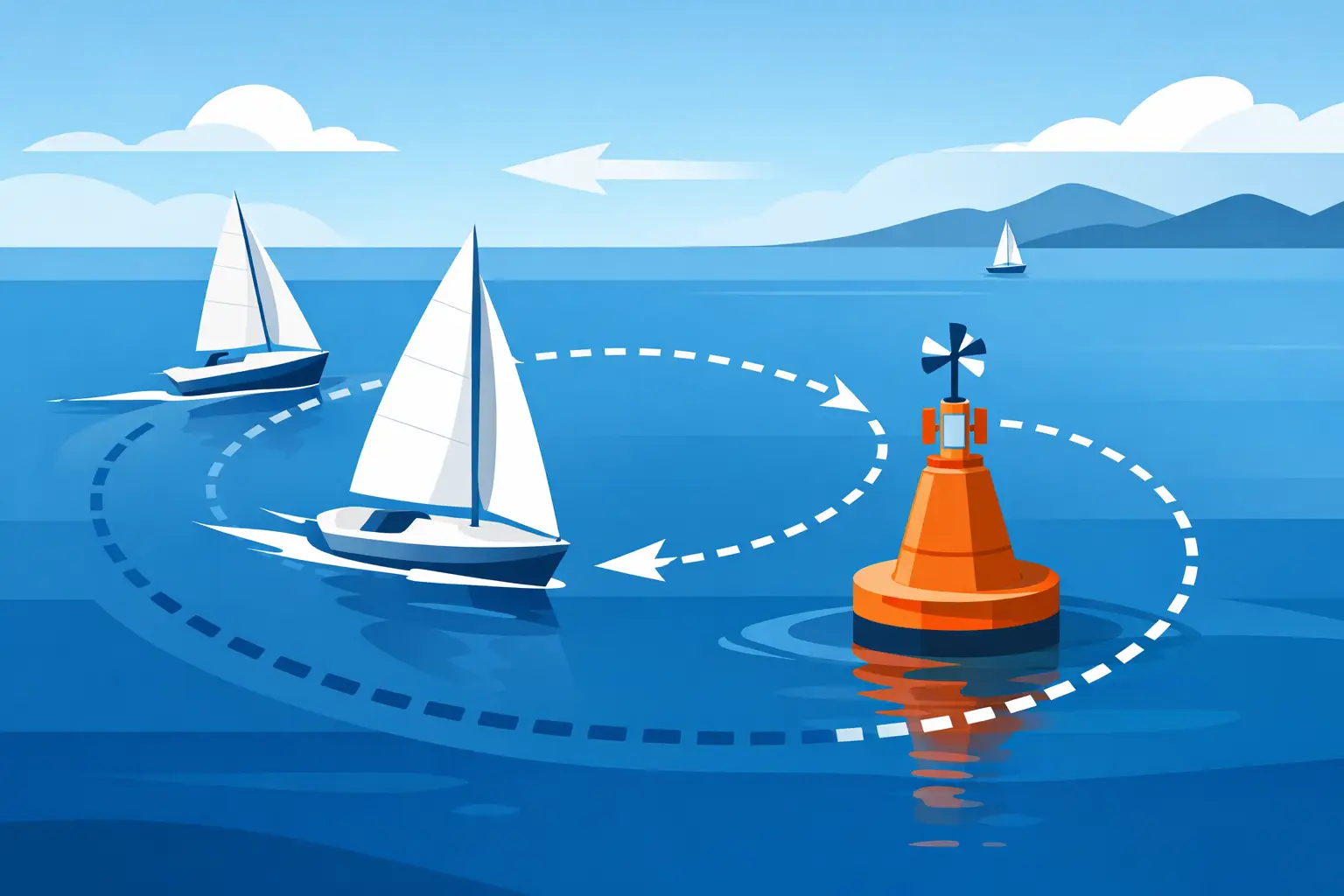
The windward mark isn't just the point where the boat turns. It's where decisions are made that can result in a change of several positions in just a few seconds. If you came here looking for a example: windward buoy tactic, imagine this scenario: you’re on a good close-hauled tack, with boats on both sides, and the next leg will be downwind. Your decisions before, during, and immediately after the mark determine whether you’ll come out with a clear run or get boxed in behind a fleet.
The rule of thumb is simple: don’t just think about reaching the buoy. Think about how you want to exit it. In a race, gaining two meters on the approach can cost you much more if you round the mark wide, without speed, or behind another boat. Trim the sails, read the wind, and enter the mark’s zone with a plan.
Example of a windward mark tactic
Consider a windward-leeward race, with steady wind and a windward mark to be rounded on the port side. You’re approaching the layline from the starboard side, close to the mark, and notice three opponents coming in on your port side. One of them is slightly ahead of you, but there’s still room for you to choose your entry point.
The worst reaction would be to trim the sails too much in an attempt to pass everyone at the mark. By trimming the mainsail and genoa too much to gain a few degrees of angle, the boat loses speed. You’ll arrive high, slow, and with no room for an efficient rounding. The downwind opponent may take the inside, and whoever was trailing will close in with pressure.
The best decision usually starts a few boat lengths earlier. Instead of aiming for the buoy at the absolute limit, maintain your speed and approach with enough room to turn. If the boat ahead is going to round the mark tight and exit low, you can approach a little further on the outside, maintain flow in the sails, and make a rounder turn. On the exit, accelerate before you even think about fighting for every centimeter of lateral position.
That doesn’t mean the outside approach is always better. If you have the right of way on the inside and can maintain control of the boat, the inside position can be valuable. It allows you to round the mark sooner and choose your downwind course first. The point is not to treat the inside as an automatic advantage. The inside without speed becomes a trap: you make the turn, but come out with a depowered sail, a heavy rudder, and a boat on the outside throwing dirty wind at you.
What the layline is saying
The layline is the imaginary line from which you can reach the mark in a single upwind leg. It helps, but it shouldn’t dictate your strategy on its own. Reaching it too early usually puts the boat in a line of opponents, with no room to react to a gust, a roll, or a loss of speed.
In a crowded fleet, approach the layline with some margin. That way, if a boat on your port side fclose-hauled causes you to tack, if the wind shifts, or if your sail loses pressure, you’ll still have room to recover. Those who approach the layline as if it were an unavoidable track often end up overlapped, with no clean air, and forced to maneuver at the worst possible moment.
Also note the preferred side of the finish. If the buoy is slightly easier to reach on a close-hauled course, many boats will converge there. This means there’s a chance of heavier traffic, more turbulent air, and a greater risk of getting boxed in. The less obvious side may offer a cleaner approach, even if it appears a few meters longer on the map.
The approach begins before the final leg
A good windward mark rounding is executed well before the final few meters. When sailing close-hauled, be aware of who is ahead of you, who might cross your path, and which side will have right-of-way at the mark. Don’t wait until you’re two boat lengths from the mark to realize there’s a whole line of boats in your path.
If you’re clear and moving fast, it might be worth protecting the side leading to the buoy without making any unnecessary maneuvers. If you’re in choppy winds, an early tack can give you clean air and open up a more controlled approach. It’s the classic balance of racing: sailing the shortest course isn’t always the same as sailing the fastest course.
Gusts change the landscape. On a close-hauled run in a gust, the boat heels over more and tends to want to point up. Control the rudder, flatten the sail if necessary, and avoid turning extra power into drag. A well-executed gust can take you in front before you reach the mark. A poorly controlled gust can force a sudden correction and hand the inside to your opponent.
Circle to speed up, not to survive
Once you reach the buoy, the goal is to trade upwind power for downwind acceleration. Start easing off the sails as the boat turns. If you keep everything trimmed as if you were still tacking, the sail will be at the wrong angle for the new course, and the boat will be slow to pick up speed.
The teacher should monitor the change in direction, and the genoa needs to breathe. Ease off the sheet gradually, sensing the moment when the sail fills again in the new apparent wind. On a turn that’s too sharp, the boat loses speed and the rudder acts as a brake. On a turn that’s too wide, you sail extra meters. Aim for a smooth, steady, and continuous course.
Right after the mark, look behind you and to the sides. If an opponent comes out too high, they may end up with no pressure on their sail and leave room for you to drop down with speed. If they come out low and fast, it might be better not to try to cover them right away. First, get your boat moving. Marking only works when you’re in control; trying to mark someone without speed is a quick way to get stuck in their dirty wind.
The apparent wind changes when turning
This detail explains why many starts seem slow. When sailing close-hauled, apparent wind It comes from ahead, because the boat's speed adds to the true wind. When you round the stern, it shifts backward. The sail, which was well trimmed, is no longer set for that new angle.
In practice, steering is a visual and sensory process: heel the boat, ease off the sheets, and feel for pressure on the sails. If the sail flaps too much, you may have eased off too early or lowered it more than necessary. If it feels stuck and the boat isn’t picking up speed, it’s probably still too tight. Make small adjustments and observe how the hull responds.
When to attack and when to hold ground
Not every turn calls for aggressive racing. If you’re in the lead and have a clear exit, focus on avoiding mistakes. Take the turn smoothly, accelerate, and let your opponents sort out the traffic behind you. The lead is worth more than a showy maneuver to block every line.
If you’re in the middle of the pack, making a move might make sense, but it needs to be purposeful. Go on the inside when there’s space and speed to complete the maneuver. Look for an opening on the outside when the inside is congested. And if your approach was poor, accept losing a few meters to avoid a situation that could cost you ten positions.
In multiplayer regattas, reading the behavior of other boats is just as important as the course layout. Some sailors are overly cautious around the mark, some always round it wide, and some forget to ease off the sails on the exit. Identify patterns. A single mark doesn’t decide the entire race, but it reveals opportunities that repeat themselves on every lap.
Practice making your decision before the official start
In VelejAÍ, you can recreate the same situation without relying on a marina, an available boat, or favorable weekend winds. Approach along the layline, then try to arrive with more room to spare. Round the mark by bearing away too much, and compare it to a exit where you ease off the sails at the right moment. The gain comes from the boat’s movement, not from a memorized maneuver.
Also practice with this rule: every time you pass a buoy, consciously choose your priority. It could be protecting the inside, maintaining speed, finding clean air, or exiting on the desired side of the stern. Then, see what happened. When you connect decision-making, course adjustment, and the result, tactics stop being a guess.
In the next race, don't just aim for the buoy. Aim for the exit that sets your boat free, accelerating and ready for the next challenge. That's where a good approach translates into a position gained.