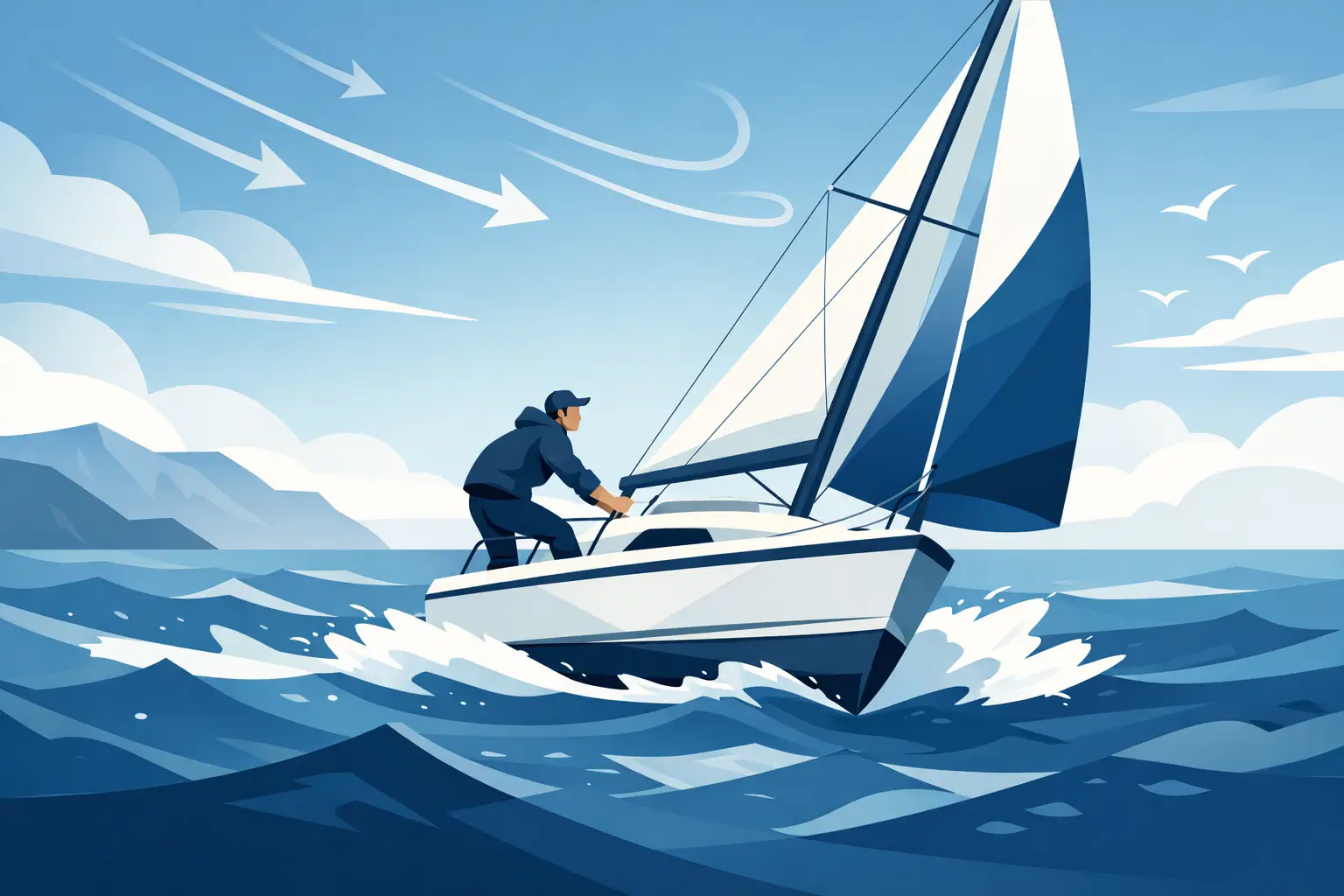
When the bow is pointing into the wind, the boat won’t pick up speed no matter how hard you try. The sails start to flap, the rudder loses responsiveness, and it feels like there’s no fclose-hauled. But sailing into the wind isn’t about fighting the wind—it’s about finding the right angle, trimming the sails, and zigzagging your way to your destination.
This is one of the first key concepts for beginners in sailing. You can’t sail directly upwind, but you can get there by sailing two legs against the wind. And once you understand how the apparent wind affects the sail and the hull, the maneuver no longer seems like a mystery.
What happens when you sail into the wind
Every sailboat has a dead zone, also known as a non-sailing zone. It is the area in front of the boat where the wind hits so head-on that the sails cannot generate efficient propulsion. The size of this zone varies depending on the boat, the sail design, sea conditions, and the sailor’s skill in trimming the sails, but it exists on every sailboat.
Instead of pointing the bow directly at the wind’s source, you sail on close-hauled, usually with the wind coming from ahead and from one side. The sail acts like a wing: air flows over both sides of the sail and creates a fclose-hauled that pulls the boat forward and also to the side.
That’s where the keel, the bow, or the underwater sections of the hull come into play. They resist lateral drift and convert part of that fclose-hauled into forward motion. Without that balance between the sail and the underwater sections, the boat would slide sideways instead of making headway against the wind.
The goal, therefore, is not to find the straightest route on the map. It is to find the best balance between heading directly toward the destination and maintaining speed. A boat that’s set too close to the mark may seem closer to the buoy, but if the sails have no wind in them, it will come to a stop. A boat that’s set a little further off course and is faster often arrives first.
Find the bracing angle
Tuning starts with the course. Gradually head upwind and watch the sails. As long as they remain full and the boat continues to move with pressure on the rudder, there is enough power to sail. When you sail beyond the limit, the luff of the sail begins to flap, the boat loses momentum, and the bow tends to list to one side.
This tip is useful. Don't wait until the entire sail flaps before making a correction. If the front of the genoa or the mainsail starts to flutter, ease off a few degrees until it fills out again. This slight easing can restore speed without sacrificing much course.
In practice, the best angle depends on three factors: wind strength, sea conditions, and the boat’s characteristics. In light winds, it’s usually worth opening the course a little more to build speed and apparent wind. In strong winds and rough seas, pointing too much also takes its toll, because the hull hits the waves and slows down with each impact.
In a race, compare performance, not just the direction of the bow. If another boat appears to be sailing lower but is moving noticeably faster, it may be using a more efficient trim. The correct question isn’t “Who is sailing closer to the wind?”, but rather “Who will reach the next mark first?”
Apparent wind changes everything
The wind you feel on board isn't just the actual wind. It combines with the wind created by the boat's own movement. The result is the apparent wind, and it is this that determines the pressure in the sails.
When the boat picks up speed while sailing upwind, the apparent wind tends to become stronger and shift further forward. Therefore, a small gust can allow you to bear away slightly, as long as you keep the sail working. On the other hand, when you lose speed, the apparent wind weakens and shifts aft, requiring a course correction or a trim adjustment.
This relationship explains why sailing requires constant attention. You don’t just adjust the sails once and forget about it. With every gust, wave, and change in course, the angle between the apparent wind and the sails changes.
Adjust the mainsail and genoa to gain pressure
On the other hand, the The sails are set closer together. The genoa or jib should be trimmed in until it is close to the center of the boat, but not too much. If you trim it in too much, the back of the sail closes up and the airflow breaks away. If you leave it too loose, the sail loses the shape needed to generate fclose-hauled.
Use the genoa luff lines as a reference, when available. Ideally, both sides should run cleanly. If the inner luff lifts first, the sail is too tight or the boat is bearing away too much. If the outer luff lifts, it may be time to luff off a little or gently bear away.
The mainsail needs to be adjusted to match the genoa. If the genoa is set too wide, the boat loses balance and power. If it’s too tight, it increases heel and can create drag. Watch the head of the mainsheet: a slight, controlled flutter near the mast may indicate that you’re at the efficient limit, but fabric flapping too much means wasted wind.
Heeling is also a form of feedback. A slight heel is natural and helps you feel that the boat is loaded. Excessive heel, however, increases steering resistance and causes the boat to want to point up. Before fighting the helm, ease the fclose-hauled: slacken the mainsheet a little, reduce the angle of attack, or use the available adjustments to flatten the sail.
A simple rule helps beginners: first get the boat moving, then fine-tune the course. With the sails full and the hull picking up speed, it’s much easier to gain height without entering the dead zone.
Get past the pack without losing speed
To reach a mark positioned against the wind, you alternate tacks. This change of direction is called a tack. It allows you to go from a close-hauled course on one tack to a close-hauled course on the other, crossing the wind’s direction with the bow.
The maneuver begins at speed. Before turning, make sure the boat is moving well and that there is enough space to complete the turn. Gradually turn the bow into the wind. As the headsail loses pressure, it will cross over to the other side. Once the bow has passed through the wind, adjust the sheets and stabilize the new course.
The classic mistake is to turn while the boat is moving slowly or to turn the helm all the way at once. In that case, the boat can end up close-hauled, with the sails flapping and no fclose-hauled to finish the maneuver. That’s called being on the irons. To get out of it, ease off the sails a little, let the bow drop to one side, and regain pressure before trying point up again.
Also, don't make unnecessary tacks out of anxiety. Every tack costs you distance and speed, especially in light winds. If you tack for no reason, you might gain a few seconds of the feeling of control but lose crucial meters on the water. Choose to tack because it improves your course toward the mark, follows a wind shift, or avoids an area of poor wind.
When Is It Worth Stretching the Edge?
Imagine that the buoy is ahead and slightly to the left. If you’re on the leg heading toward it, it might be tempting to tack early to “shorten” the course. But tacking too early could leave you without enough room to reach the mark on the other leg.
Stretching the tack means continuing a little further before tacking, creating room for the final approach. The right spot depends on the wind angle, the current, gusts, and the boats around you. In a regatta, it’s also worth protecting the windward side of the course: if the wind is stronger on the right, for example, staying in that sector can yield more speed, even if the path seems less direct.
There is no single correct answer. The best navigator combines course, speed, and an assessment of the situation. That is exactly why two vessels heading to the same destination may choose different sides.
Use bursts and rolls to your advantage
A gust increases the fclose-hauled in the sails and usually requires a quick response. If the boat heels too much, start by loosening the mainsheet slightly. This reduces power and helps the rudder become light again. When the gust passes, trim the sail again so the boat doesn't lose pressure.
A roll is a change in the wind’s direction. If the wind shifts toward your bow, your wind angle becomes less favorable, and you may need to bear away slightly to maintain speed. If it shifts toward your stern, you can point up and gain height. Small corrections, made early, are more effective than large rudder movements after the boat has already lost momentum.
Avoid sailing while looking only at the bow. Feel the pressure, watch the sails, and observe the hull’s angle. Sailing is a sport of cause and effect: if you heel too far to leeward, the rudder feels heavy; if you heel too far to windward, the bow lifts; if you ease off at the right moment, the boat surges forward.
Practice before taking your question to the starting line
Your form improves with mindful repetition. Instead of trying to do everything at once, choose one focus per workout. During a session, pay attention only to when the Genoa begins to falter. In another exercise, perform turns while maintaining speed. Then, try responding to gusts first with the mainsheet and only then with the rudder.
In VelejAÍ, you can test these relationships right in your browser: change course, adjust the mainsail and genoa, watch the hull heel, and repeat the maneuver without relying on a marina, equipment, or perfect weather forecasts. Practice freely, and when you’re confident, race against bots or challenge friends to a live rematch.
The goal isn't to keep the bow as close to the wind as possible. It's to move the boat forward in a controlled manner, maintain speed during maneuvers, and choose the right tack. The next time the sails start to flap, don't force it: ease off a few degrees, regain pressure, and let the wind show you the way.