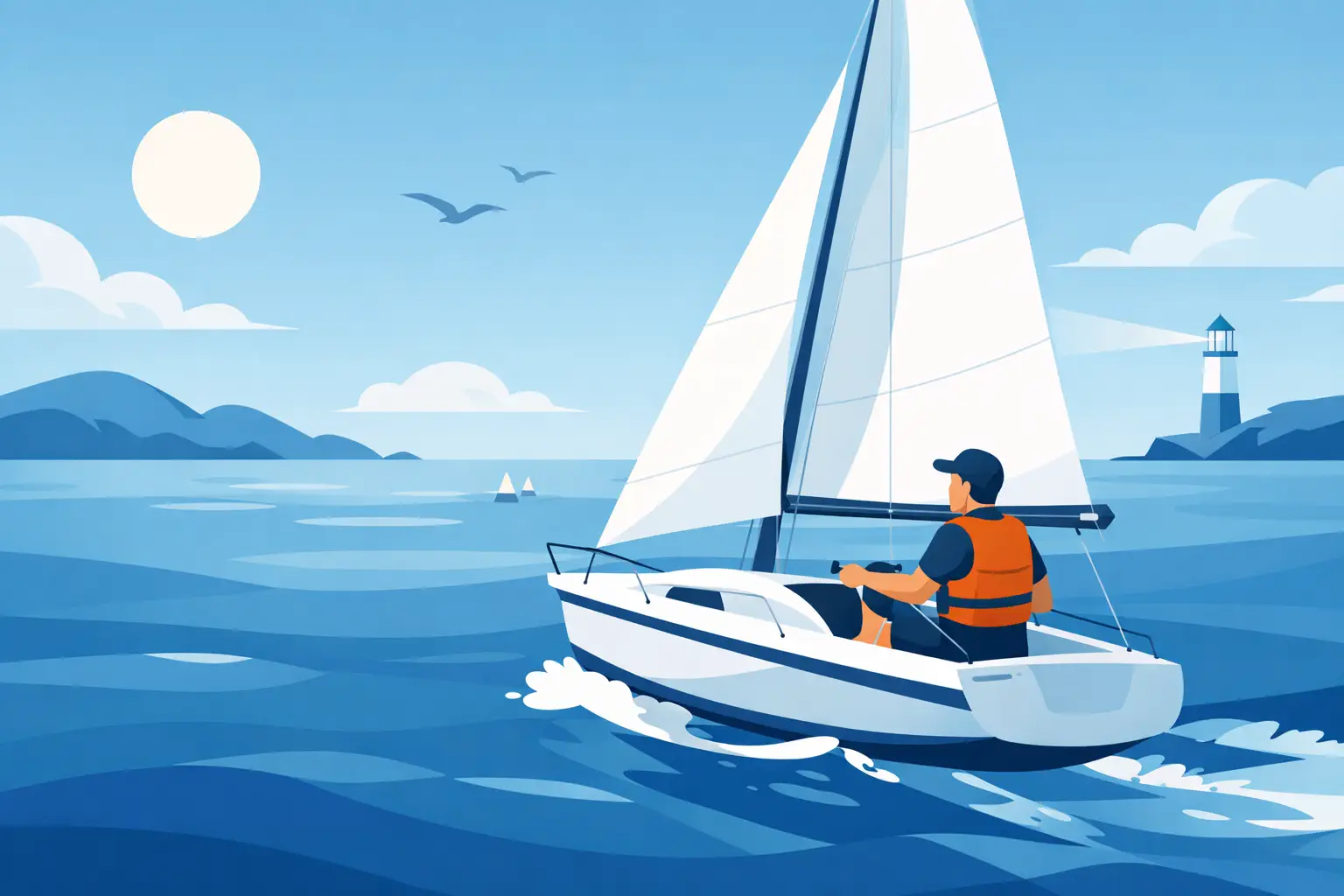
The first time a sailboat responds to the right trim is unforgettable: you ease off the sail, the boat picks up speed, heels over a little, and the course starts to make sense. But before you seek out that feeling on the water, it’s worth understanding what it means How to Learn to Sail on Your Own. You can study, practice making decisions, and develop your judgment on your own. But setting out alone in a real boat with no experience is a different story—and it shouldn't be your starting point.
Sailing rewards experimentation, as long as it takes place in a controlled environment. Start with the basics, repeat the scenarios until you recognize cause and effect, and apply what you’ve learned to a practical lesson or a guided sail. That way, each command stops being a guess and becomes a conscious choice.
Learn the logic before memorizing the names
Beginners often try to memorize a list of terms: bow, stern, starboard, port, mainsail, genoa. These terms are useful, but they don’t make the boat move on their own. The basics of sailing are simpler: the wind hits the sail at an angle, the sail generates fclose-hauled, and the hull converts part of that fclose-hauled into forward motion.
The first exercise is to observe the wind directions. Sailing directly into the wind doesn't work. There is an area, called the dead zone, where the sailboat loses pressure in the sails and stops moving forward. To reach a point that is upwind, you need to tack in a zigzag pattern, alternating tacks with bow turns.
When the wind is coming from the side, you’re sailing broad reach—a generally fast and stable course. When it’s coming from behind, you’re sailing downwind, where the sail needs to be set wider. The difference isn’t just theoretical: the wind angle changes the sail trim, the boat’s heel, and even the maneuver you’ll need to make next.
Don't try to get everything right at once. Choose a course, watch the sail, and make one adjustment at a time. Luff a little to turn the bow away from the wind. Trim the sheet until the sail stops flapping. If it closes too much and the boat heels over without picking up speed, ease off. This sequence teaches you what no glossary can.
How to Learn to Sail on Your Own Using a Simulator
A simulator It's a good place to make mistakes without turning a burst, a pier approach, or a miscalculated maneuver into a problem. At VelejAÍ, you enter via the browser and you can steer the boat, feel the rudder's response, adjust the mainsail and genoa, and compare the results of each choice with the prevailing wind.
Start with a steady wind. Keep the boat on a broad reach and try trimming and slackening the sails in small increments. When the sail is too slack, it flaps, or beats without forming the profile needed to generate fclose-hauled. When it’s too tight for that course, it also loses efficiency and can cause the boat to heel more than it should. Find the point where the flapping stops and speed is maintained.
Next, steer the boat in different directions without immediately adjusting the sails. The reaction demonstrates why a trim is not a fixed position. At point up, as the bow approaches the direction of the wind, the sails require more tension. When bearing away—moving the bow away from the wind—they require more slack. The sail needs to be at the right angle to the wind, not at the angle that seemed right a minute ago.
Once this feels natural, add gusts and shifts. A gust increases the fclose-hauled on the sail and can cause the sailboat to heel. If you just pull on the tiller to compensate, you may slow the boat down and lose control. Often, the best response is to relieve the pressure by easing off the sail and, if necessary, luffing slightly. A gybe, on the other hand, changes the direction of the wind and requires anticipation: the course may remain the same, but the sail is no longer properly trimmed.
Repetition is the real benefit of this training session. Do a short session with a clear goal: today, maintain a beam reach without luffing; tomorrow, execute ten clean tacks; then, control the boat in gusts. Instead of sailing for half an hour without paying attention to anything, sail for ten minutes focusing on a single variable.
Practice the maneuvers that prevent you from having to improvise
A bow turn occurs when the bow crosses the direction of the wind. Before starting the turn, pick up speed and leave some space ahead. Turn the helm gradually, watch the mainsail pass by to the side, and switch the genoa when it loses pressure. If you turn too quickly or forget to release the sheet, the boat may come to a stop in the dead zone.
The jibe, or stern turn, deserves even more respect. During a jibe, the stern crosses the wind and the mainsail swings wildly from side to side. On a real boat, an uncontrolled swing can injure someone, damage equipment, and destabilize the vessel. Practice first in moderate winds, keep the mainsheet under control, and make smooth movements at the helm.
It’s also worth practicing stopping. A sailor who knows how to accelerate but doesn’t know how to ease off the pressure is at the mercy of the boat. Point the bow into the wind, ease off the sails, and notice how the speed drops. This insight will be useful when waiting at the starting line, approaching a buoy, or regaining your composure when a maneuver doesn’t go as planned.
Use tank tops to turn technique into a decision
Sailing without a goal can teach you sensitivity. Racing teaches you to set priorities. At the start, you need to choose your position, control your speed, and avoid crossing the line too early. On the upwind leg, you decide whether it’s worth sticking to one tack or tacking to take advantage of a wind shift. On the downwind leg, you seek speed without losing control of the sail.
You don't have to start by racing against experienced sailors. Timed races against bots help you track your progress and highlight your mistakes. Did you lose time because you tacked without enough speed? Because you let the genoa flutter? Because you entered a gust with the sail too close-hauled? Run the course again and change one decision at a time.
When you want some real excitement, invite your friends over for a live regatta. Competition provides context for concepts that seem abstract. Suddenly, a burst of speed is no longer just a visual effect: it’s a chance to gain meters. A poor line choice is no longer just a technical mistake: it opens up an opportunity to pass.
What you can't fully learn on your own
Simulation and study lay the foundation, but they do not replace guidance during the first physical experience. In real water, there are waves, currents, boat traffic, cables, depth, equipment, and weather changes that require on-site assessment. The body also experiences forces that the screen merely simulates: balance in the cockpit, the heave of a sail, the sound of the wind, and the distance to the shore.
Therefore, the safest way to transition is to practice on your own in a digital environment and take your first real outings with an instructor, a sailing school, or an experienced sailor. Wear a life jacket, let someone know your sailing plan, check the forecast, and choose calm conditions. If there’s strong wind, a developing storm, or you’re in an unfamiliar area, postpone your trip. The decision not to go out is also part of good sailing.
In some situations, truly sailing alone may be appropriate for those who have mastered the boat, know the area, and have a safety plan. For a beginner, however, independence does not mean isolation. It means understanding what you’re doing, recognizing your limits, and asking for help before you need it.
A Simple Routine for Personal Growth
Schedule frequent, short training sessions. In the first few days, focus on course selection and trim. Next, practice tacks, jibes, and speed control. Then, incorporate gusts, rolls, and courses with buoys. Only then should you make race strategy the focus of the session.
Keep three signs in mind: when the sail starts to flutter, when the boat picks up speed, and when the heel goes beyond the comfortable point. These signs connect vision, control, and result. Over time, you won’t need to think about each step. You’ll look at the sail, feel the pressure, and adjust almost immediately.
The best way to move forward is to stay curious: trim the sails, make mistakes in a safe environment, repeat the maneuver, and watch how the boat responds. When the time comes to get on a real sailboat with an instructor, you won’t just be cruising around. You’ll be ready to see how the wind works.