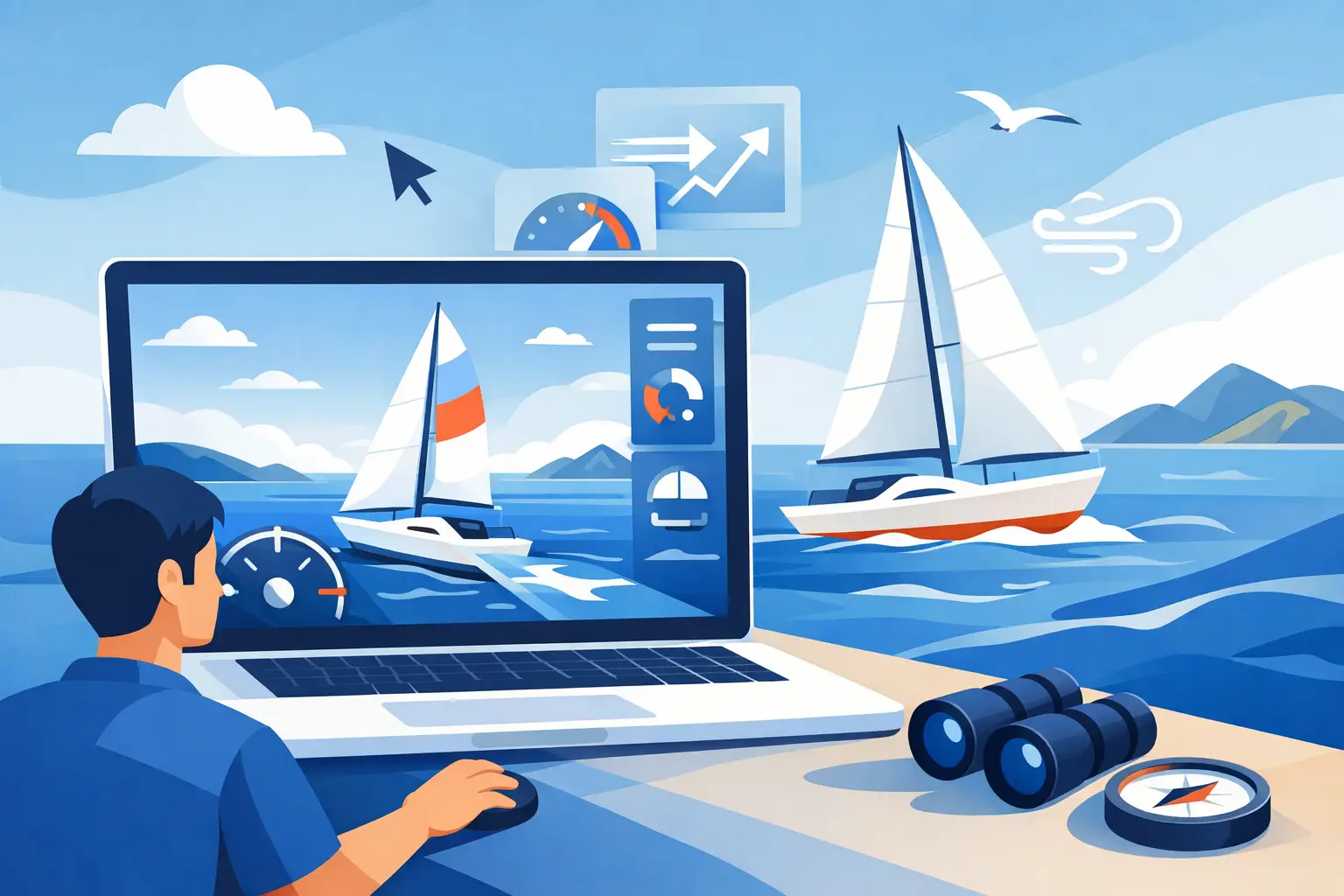
The boat heels over, the bow loses speed, and you realize that simply heading toward the buoy isn't enough. You have to read the wind, choose a course, and trim the sails at just the right moment. A free browser-based sailing simulator It brings that experience to the screen without requiring a boat, a club, equipment, or any setup. You open the app, take the helm, and learn by seeing the consequences of each decision.
For those who have never sailed before, this is a direct gateway to a sport that often seems out of reach. For those already familiar with Guaíba, the racecourse, or the regatta routine, it’s a chance to practice wind reading and strategy between tasks. Take to the virtual waters and let the boat be your teacher.
What a browser-based sailing simulator needs to offer
Not every boat game teaches sailing. In a useful simulation, the sailboat doesn’t just speed up because the user pressed a button. It responds to the wind angle, the chosen course, the position of the sails, the rudder, and the behavior of the hull. When these elements interact with one another, every maneuver takes on a cause and effect.
The browser solves a major practical hurdle: there’s no file to download, no update to wait for, and no specific computer to set up. Whether on a cell phone, tablet, or computer, just open the page and get started. This convenience doesn’t replace real water—with its waves, currents, and unpredictability—but it helps you build a foundation before your first lesson and keeps your mind active even when you’re away from the boat.
In VelejAÍ, the idea is precisely to put the user in control of a free 3D simulation. You can take a free practice session to get the hang of the controls, race against bots in a timed regatta, or share a room to compete live with friends. With no required registration, ads, or in-app purchases, your focus stays where it should be: on the wind and the next mark.
How to Get Started with a Free Browser-Based Sailing Simulator
Your first sail doesn't have to be a test of nautical terms. Start by observing the wind direction shown on the screen and steer the boat in different directions. When sailing closer to the direction the wind is coming from, the sailboat tends to require precision. If you try to point directly into the wind, the boat loses pressure in the sails and speed. This area is called the dead zone.
Try turning the bow slightly away from the wind. Once you find a navigable angle, adjust the sail so that it stops flapping loosely and starts working effectively. The visual cue is important: a well-trimmed sail receives a steady flow of air; a poorly positioned sail sags, flutters, or slows the boat down.
Don't try to do everything at once. First, maintain a course. Then, adjust the mainsail or genoa and pay attention to your speed. Finally, make smooth turns with the helm. Sailing teaches by contrast: if you let the sail out too much, you lose power; if you tighten it too much, the sail may stop working properly. The right balance depends on your course and changes as soon as the wind shifts.
Understand apparent wind before pushing for speed
The wind you feel on the boat isn't just the actual wind in the surroundings. As the sailboat moves forward, its own displacement alters the direction and intensity of the wind perceived by the sails. This is the apparent wind. It explains why a fast boat may require a new trim even without a clear change in the wind shown on the chart.
In practice, observe what happens after you accelerate. If the apparent wind shifts forward, you may need to trim the sail. If the boat slows down after a turn or a gust changes the wind pressure, the previous adjustment may no longer work. This skill is one of the most valuable in sailing, and a simulator allows you to practice it dozens of times without relying on perfect conditions.
Use bursts and rolls as information
A gust isn't just stronger wind. It can increase heel and require a quick response at the helm and with the sails. If the hull heels too much, the boat can take on more water, become hard to handle, and lose efficiency. Sometimes, the best choice is to ease off the sail; other times, it’s to correct the course before the pressure builds.
A single gust can change the wind direction. It may not look like much on the screen, but it alters the race dynamics. A small change can turn a promising tack into a slow journey to the mark. Train your eye: what looked like poor tacking might actually be a shift in the wind.
From Basic Maneuvers to Your First Race
With the basics under control, it’s time to link technique and objective. In a regatta, it’s not just the sailor who keeps the boat moving fast in a straight line who wins. The start, the choice of side of the course, the timing of the tack, and the approach to the mark all make a difference. Speed creates opportunities, but strategy determines where they lead.
Start with a single buoy. Approach it from different directions and figure out which paths allow you to reach it without entering the dead zone. Then, perform a tack: turn the bow into the wind to change tack. During the maneuver, the sail may lose pressure for a few moments. Anticipate the adjustment so the boat regains speed immediately after the turn.
The jibe requires a different kind of attention. During a jibe, the stern crosses the wind and the sail swings from one side to the other. In strong winds, a sudden change can destabilize the boat. In the simulator, you can repeat the sequence until you understand the timing of the rudder and sail. On the water, this mental practice helps, but executing the maneuver always requires supervision, space, and respect for local conditions.
Once you feel comfortable, enter a timed race against bots. It provides enough pressure for you to notice mistakes that go unnoticed during free practice. Did you get off to a slow start? Maybe you reached the line too early or chose a course with no room to maneuver. Did you lose ground at the first mark? Review whether it was worth sticking to that tack or if an earlier gybe would have put the boat in clean air.
Should I train alone or play with friends?
It depends on what you want to work on. Individual training is best for testing things out at a leisurely pace: change one variable, observe the effect, and repeat. Sail the same course by adjusting the sail first earlier and then later. Sail the same course at different angles. This type of repetition builds a memory of cause and effect.
As for the multiplayer match It adds an element that physics alone doesn’t teach: decision-making under pressure. In a live start, other boats take up space, force you to change your plan, and turn a simple choice into a matter of seconds. Share the link to the race, round up a crew of friends, and set up a rematch. Even beginners learn a lot by comparing courses and discussing a successful tack or a sudden gust that caught everyone by surprise.
Competition doesn't have to mean racing blindly. Use each race as a learning experience. If another boat gained ground, ask yourself whether it found more wind, sailed at a more efficient angle, or simply made fewer mistakes during the transitions. That curiosity turns a narrow defeat into a lesson for the next start.
What Simulation Teaches and What It Cannot Replace
A good simulator helps you develop an understanding of course, trim, apparent wind, hull response, and racing strategy. It also helps you overcome your initial fear of the controls. Instead of showing up to an in-person class trying to remember which line to pull, you’ll already have an idea of why the sail needs to be at the right angle to the wind.
But there are realistic limits. The screen cannot fully replicate the body’s balance, the sway of the water, the physical feel of a sheet, communication with a crew, or the safety precautions involved in real sailing. Setting out with an instructor, wearing the proper life jacket, and paying attention to the weather remain essential for learn to sail in practice.
This difference doesn’t diminish the value of the simulation. It defines its best use: practicing concepts, testing decisions, and fueling the desire to sail. When the time comes to get on a boat, you won’t be starting from scratch. And when you get out of the water, you can return to the screen, adjust the sails once more, and prepare for the next race.