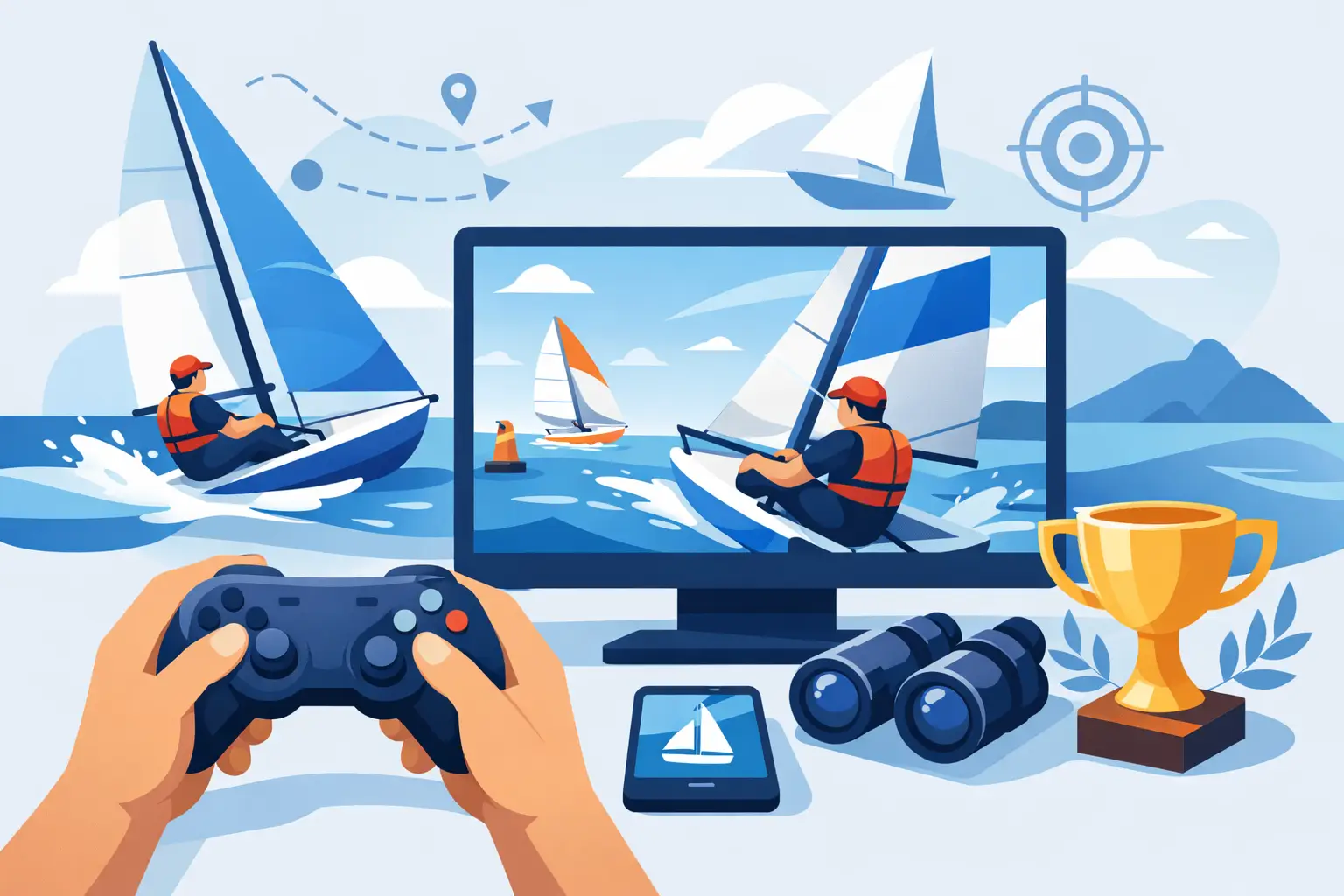
The boat heels over, the bow points too high, and the speed drops. You ease off the sheet, correct the helm, and feel the hull pick up speed again. It’s this direct relationship between decision and result that makes water sports such an interesting introduction to sailing. Even without your own boat, a sailing club, or perfect weather forecasts, you can already begin to understand what the wind requires from each adjustment.
For those who’ve always been curious about sailing, the screen bridges the gap between watching a sailboat on the water and taking the helm. For those already familiar with a race course, it creates the space to practice starts, test different routes, and see how a gust of wind can change the entire race. The point isn’t to memorize terms before you start. It’s to trim the sails, make a few mistakes, observe how the boat reacts, and try again.
What Makes Water Sports Different
Not every game featuring the ocean, a speedboat, or a boat is a sailing simulator. In water racing games, speed usually depends mainly on accelerating and navigating around buoys. In sailing, the engine is invisible and variable: the wind. This turns every stretch of the course into a continuous assessment of angle, pressure, and direction.
Good sailing presents you with choices that also exist on the water. If you point too close to the wind, the boat may lose airflow in the sails and come to a stop. If you bear away too much, you may sail fast, but you’ll cover a longer distance to the buoy. If you keep the sails trimmed too tight when a gust hits, the hull may heel too much and the rudder may become heavy.
That’s the beauty of it. Sailing doesn’t just reward reflexes. It requires anticipation. You observe the conditions, choose a course, adjust the mainsail and the genoa, feel the effect, and adjust again. When the physics respond consistently, the sail is no longer just a backdrop—it becomes a training ground for real nautical decisions.
Water sports for beginners
For many people, the first hurdle isn’t technical. It’s the belief that you need to know everything before you can sail a boat. In practice, the basics become clearer when you get to try them out. Start with a casual session in steady wind, and focus on just three things: where the wind is coming from, which way the bow is pointing, and how the sails are set.
Sailing directly into the wind doesn't work. To move toward a point upwind, you need to tack, alternating the sides you’re sailing on. This discovery is even more valuable when you experience it in practice: you try to sail straight, watch your speed drop, and understand why it’s necessary to point up, turn, and gain ground little by little.
Start with a simple lap
Choose a buoy and sail a short course. At first, don’t worry about setting the best time. Try to keep the boat stable and moving. With the wind coming from the side, adjust the sails until you find the point where they fill out without flapping. Then, move the tiller gently. Overcorrecting will slow the boat down and may take the sails out of the right angle.
When changing direction, note the difference between jibing and tacking. During a jibe, the bow passes through the wind, and the sails switch sides. In a tack, the stern crosses the wind, usually at a higher speed, but this requires attention because the main sail shifts to the other side with fclose-hauled. On a simulator, you can repeat these maneuvers without the pressure of having to get everything right on the first try.
Learn how to read the apparent wind
The wind that the boat feels is not just the wind in the environment. As the sailboat picks up speed, it creates an apparent wind coming from ahead. For this reason, a setting that worked at low speeds may need to be adjusted when the boat accelerates.
That's where a well-crafted game teaches through cause and effect. He hunted too much And the boat started to heel? Maybe it’s time to ease off the sail a little or adjust your course slightly. Did the bow drop and the sail start flapping? Recover your angle to the wind before pulling it in again. There’s no single sail setting that works for every course. The sail needs to be at the right angle for the wind as it’s coming at that moment.
Bursts and rolls make the experience even more interesting. A gust increases the fclose-hauled in the sails and can boost speed, but it also requires control. A shift changes the wind direction and can turn a tack that seemed excellent into a bad choice. Instead of treating these variations as bad luck, use them as information. Whoever notices them first usually gets ahead.
How to Choose Water Sports Games That Really Teach You Something
If your goal is just to spend a few minutes racing on the water, any game featuring boats can be fun. But if you want to build your sailing skills, it’s worth looking for resources that clearly show the relationship between steering and performance. The boat should respond to the helm with inertia, the sails need to influence propulsion, and the wind should change your strategy—not just serve as window dressing.
It also helps to have the freedom to train without interruptions. A short session in your browser—accessible via your phone, tablet, or computer—makes it easy to practice. You can do a few sets throughout the day, test a start before leaving home, or challenge friends to a race in the evening.
VelejAÍ follows this approach by bringing sailing physics, steady wind, gusts, tacks, the mainsail, the genoa, and online regattas into a free browser-based experience. The idea is simple: jump into the virtual water, fiddle with the controls, and see what happens to the boat. The theory makes sense when the bow rises, the sail loses pressure, and you find the right correction.
There is a healthy limit to this comparison. No game can replace the physical sensation of a real boat, safety precautions, interacting with the crew, or fully assessing the conditions of a course. The simulator serves as preparation and mental practice. It shortens the learning curve, but the water remains the place where the wind, waves, and equipment reveal all their nuances.
Regattas Turn Practice into Strategy
Sailing alone teaches self-control. Competing in a regatta adds pressure, positioning, and risk assessment. At the start, arriving too early can mean crossing the line before the signal. Arriving late forces you to seek free wind while the other boats have already picked up speed. A good start depends not only on speed: it depends on room to maneuver and a clear course in the first few meters.
Throughout the race, the question changes. It’s not just which course makes the boat go faster, but which path gets you to the next buoy before your opponents. Sometimes, it’s worth heading to one side of the course because there’s more wind pressure there. Other times, it’s better to protect your position from those coming up behind you, even if the route seems less aggressive.
Races against bots are useful for learning the course and building confidence without having to wait for other participants. In live multiplayer, however, every move has social and competitive consequences. A friend who crosses in front of you can steal your wind. A well-timed group maneuver can clear a path. And a finish decided by mere seconds usually calls for an immediate rematch.
Get the most out of every session
Progress happens when you enter the virtual water with a specific question in mind. In one session, try to figure out at what point the sail stops flapping against the point up. In another, practice only tacking, aiming to lose as little speed as possible. Then, sail the same course twice and compare not only the final time but also the moments when the boat slowed down.
Avoid changing everything at once. If you adjust the tiller, the course, and both sails all at once, it becomes difficult to tell what worked. Make one adjustment, wait for the hull’s response, and then decide on the next step. This habit is valuable in sailing: acting quickly doesn’t mean acting without observing.
When curiosity turns into a desire to compete, join a regatta, line up at the starting line, and test your choices against others. Every mark you round teaches you something. And the best time to figure out your next adjustment is precisely when the wind shifts and the boat demands a response from you.