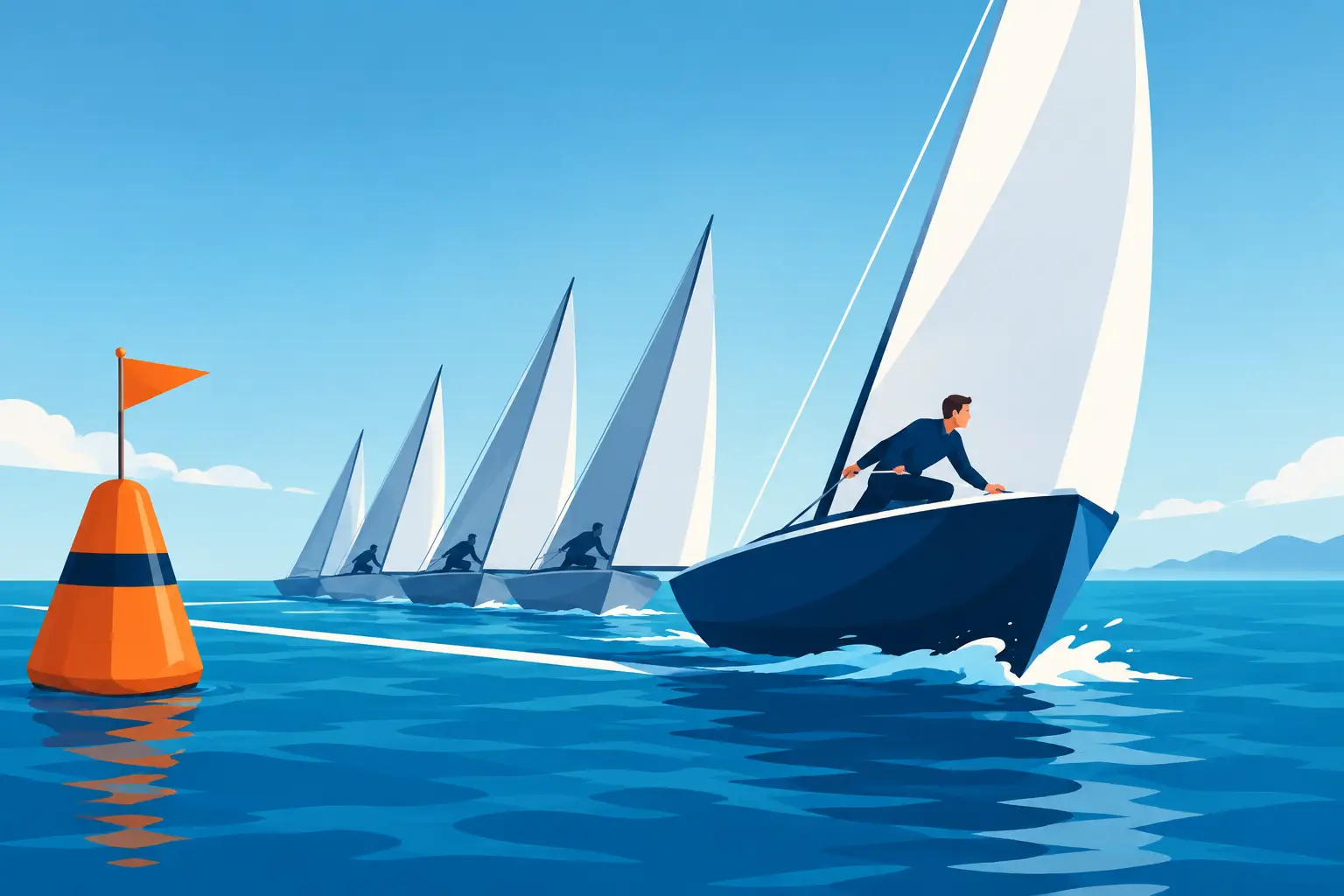
The start is not just the moment the race begins. It's when you decide whether you'll sail in clear air, fighting for the lead, or spend the first few minutes trying to escape the dirty air of other boats. Understanding how to position your boat at the start turns a seemingly simple line into a decision about speed, space and strategy.
There is no magic spot that works in every race. The best place depends on the favored end of the line, the strength and direction of the wind, the number of competitors and, above all, your ability to accelerate without getting tangled up. A good start is not, by definition, the most aggressive one. It's the one where you cross the line at the right instant, at speed and with a viable way out.
Before positioning the boat, read the line
The starting line joins two references: usually a committee boat at one end and a mark at the other. Your first job is to find out whether it is square or favors one end.
If one end is farther to windward, it lets you start closer to the wind. On an upwind leg, that usually means a geometric advantage: the boat sets off a few meters ahead in the direction of the next leg. But be careful: a favored end attracts the fleet. The advantage can vanish if you end up boxed in, with no room to keep your speed.
Make a pass along the line if there is time. Sail from one end to the other and note the boat's heading. Then compare it with the close-hauled course you are able to hold. Another practical method is to sight one end visually against a reference on shore or on the horizon. That way you know where the extension of the line lies and avoid being caught out by an early start.
Look at the wind too, not just the line. A stronger gust on one side can make up for a small geometric advantage on the other. If the wind is shifting, that is, changing direction, the apparently less favored end can open up a better route a few seconds after the gun.
How to position your boat at the start without losing speed
The goal is to approach the line under control. That means having room to accelerate and an escape route in case someone tries to take your wind. Instead of sitting head to wind in the middle of the chaos, approach by sailing parallel to the line or making short tacks, always keeping a clear area to leeward.
A useful guideline is to choose a spot on the line a few boat lengths down from the most crowded end. You give up a few meters of theoretical advantage, but you gain clean air and more freedom to adjust your position. For anyone still learning, this is almost always a better choice than fighting for the end with little time and little speed.
Arriving too early is as bad as arriving late. If you reach the line with many seconds to spare, you have to slow down. You can trim in and ease the sails, make turns or sail off to leeward, but every maneuver creates a risk of losing control or getting pinned by another boat. Arriving late, on the other hand, means watching your rivals accelerate before you do.
The aim is simple: approach the line on an upwind course, with the sail trimmed to generate power, and cross at the signal with your speed building. The boat should be accelerating, not just floating in the right place.
Create a gap to leeward
At the start, space is speed. If there is a boat very close to leeward, it can point up and shut the door on you. If there is a boat to windward, it can spill its wind onto your sails. So look for a gap where you have clean air and room to bear away a little and build momentum.
On a sailboat, accelerating means accepting a lower course for a few moments. If you try to point too high right at the gun, the sail loses power, the rudder brakes the hull and the boat goes slow. At low speed, any competitor beside you takes control of your start.
Sail into the gap, keep the bow steady and use your trim to build pressure in the sails. If the mainsail and the genoa are trimmed in too hard in light wind, the boat can stall. If they are eased too far, it won't point. Adjust to the wind strength and feel the response: when the sail is at the right angle, the hull accelerates and the helm comes alive.
Don't be a hostage to the favored end
Starting at the favored end always looks like the smartest decision, but it's a choice that comes at a price. You have to nail the timing, defend your position and still come off the line sailing. In a crowded fleet, boats that arrive late to the fight are usually forced to slow down, circle around or start with no room to bear away and accelerate.
The end is worth going for when you can get there early and under control, there is little congestion and the favored side offers a clear advantage. If the line is nearly square, prioritize clear air. A boat slightly down from the end, with speed and the option to tack, usually beats a boat sitting dead in the water in exactly the theoretically perfect spot.
The start clock rules the maneuver
Positioning without a sense of time turns into improvisation. Before the gun, note how long your boat takes to cover a known distance at starting speed. You don't need to do complicated math in every race. With practice, you begin to recognize whether you are too far away, too fast or arriving early.
In the opening minutes, use the pre-start area to feel the wind and test how the boat responds. When time is running short, commit to your chosen side and approach on a simple route. Changing plans with every gust tends to lead you into the crowd and steal attention that should be on the clock.
In the final seconds, avoid big maneuvers. A badly timed tack can leave the boat with no speed just as the line opens. If you are slightly early, it's better to ease off the pressure in a controlled way or sail a few meters to leeward, as long as you keep a way out. If you are late, accept crossing in a less ideal spot, but accelerate immediately. Trying to make it all back by pointing too high only makes things worse.
After the gun, protect your wind
Crossing the line is half the job. The first 30 seconds show whether your position really worked. As soon as you start, check who is to windward and who is to leeward. If a boat above you begins to cast dirty air over you, it may be time to tack early or bear away slightly to preserve speed.
Dirty air arrives when another boat disturbs the airflow that would feed your sails. The feeling is unmistakable: the genoa loses pressure, the boat heels less and the acceleration disappears. Insisting on pointing high in that situation rarely works. First get your power back. Then point up again when there is clean air.
It also pays to protect the side you chose for the first leg. If the plan was to go for a gust or a wind shift on the right, don't abandon it over a minor skirmish just after the start. At the same time, don't let strategy turn into stubbornness. If the whole fleet has gone the other way with more pressure, read what is happening and reassess.
Mistakes that cost you a good start
Some mistakes show up in almost every first race. The most common is sitting still on the line waiting for the gun. Without speed, you can neither defend your space nor respond to what the other boats do. Another is starting bunched up in the middle, with boats on both sides and no escape route.
Trying to win the start on your own, forgetting the right-of-way rules and the risk of collision, also takes its toll. Racing is a contest, but control is part of the technique. A defensive maneuver that makes you lose speed can give away more places than it would save.
Finally, don't treat an early start as a minor detail. Crossing before the signal means going back or taking a penalty, depending on the rule in force, and it wipes out any advantage you have built. It's better to start one second late at speed than to cross early and have to restart in the middle of traffic.
Train your reading; don't memorize a spot on the line
The fastest way to improve is to repeat different scenarios. Do starts in steady wind and then in gusts. Start near the end and compare that with a start a few boat lengths down. Try arriving too fast, slowing down and then getting your acceleration back. Each attempt reveals a direct relationship between time, trim and space.
On VelejAÍ, you can practice these decisions without waiting for a club day, an available boat or a full crew. Enter a regatta, trim the sails, watch the apparent wind and repeat the start until you recognize the moment the boat begins to take off.
Next time the countdown gets tight, don't just look for a space on the line. Look for clear air, speed and a way out. That trio is what produces the starts that put you in the fight from the very first meter.