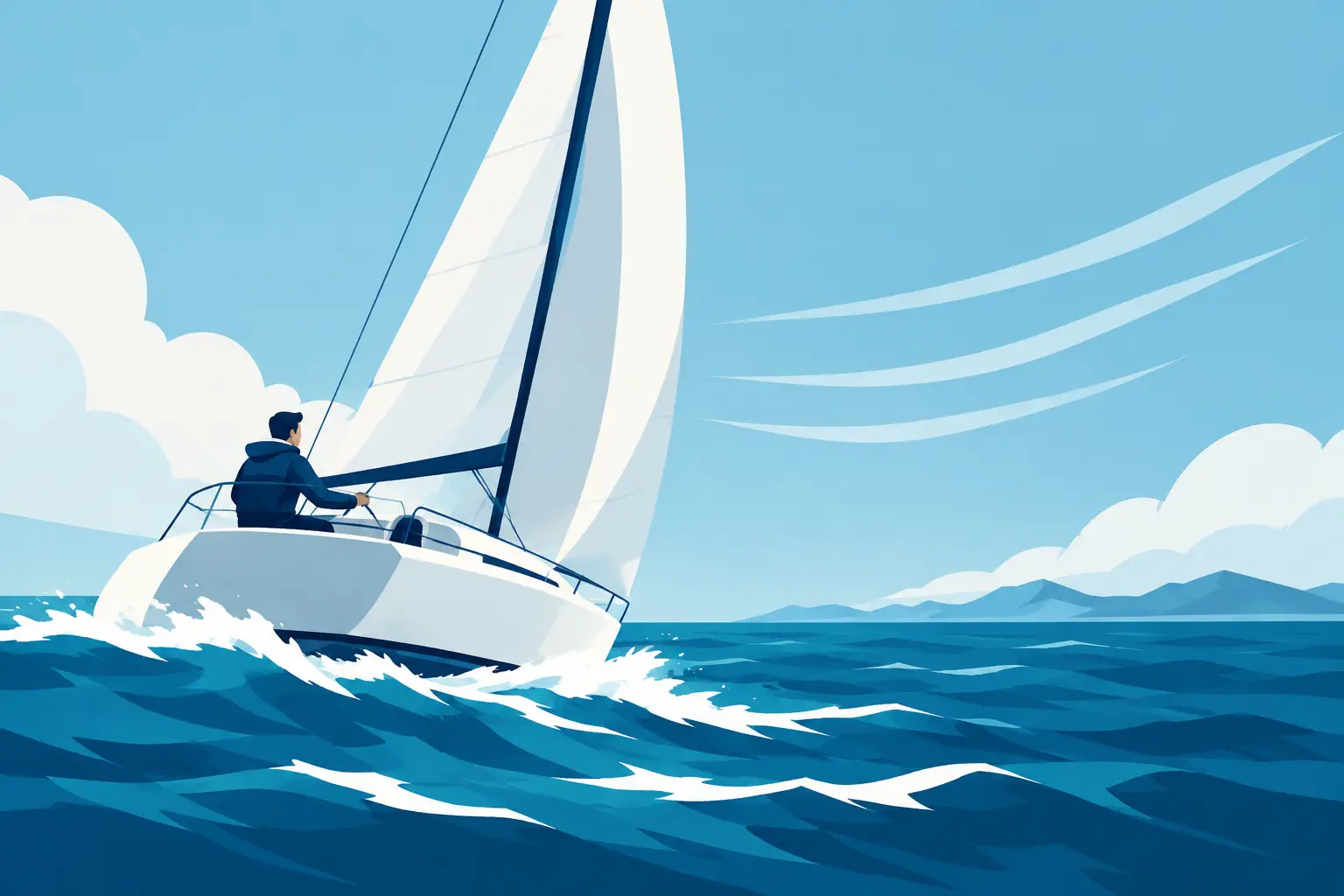
The boat is pointing at the mark, but the wind is coming from exactly that direction. Heading straight for it seems logical, except the sail loses pressure, the boat stops and the rudder goes soft. This is the moment when sailing stops being just about direction and becomes about reading the wind, trimming and making choices. This guide to sailing upwind shows how to make progress to windward with speed, control and a racer's mindset.
The first rule is simple: no sailboat can sail directly into the wind. There is a sector ahead of the boat, called the no-go zone, where the sails cannot generate enough force to keep it moving. The solution is not to fight the boat. It is to zigzag your way upwind, alternating tacks and keeping the sail working.
What sailing upwind means
Sailing upwind means sailing close-hauled, also known as pointing up or beating to windward. On this point of sail, the bow points as close as possible to the direction the wind is blowing from, without entering the no-go zone.
Instead of heading for the mark in a straight line, you advance along two diagonals. On one tack, the wind comes over one side of the boat; then, after tacking, it comes over the other. Each leg takes you a little forward and a little sideways. Added together, they deliver real gain toward the mark.
The beginner's trap is thinking that pointing higher is always better. It isn't. A course that is too tight may bring the bow visually closer to the mark, but it kills your speed. A slow boat usually makes less progress to windward than one sailing a few degrees lower, with full sails and clean airflow.
Find the close-hauled limit without killing the boat
Start by sailing with the apparent wind coming from ahead and slightly to one side. Trim the sails in little by little and point up gradually. Watch the response: if the boat accelerates, heels in a controlled way and holds its course, you are in a productive range.
Keep pointing higher until you notice the first signs of overdoing it. The boat starts to lose speed, the rudder demands big corrections or the front part of the sail starts to flutter. That flutter is the sail asking for air. Bear away a few degrees, just a touch, until it fills again.
The idea is not to chase a magic number on the display. The ideal angle changes with wind strength, the boat, the sea state and the trim. In light wind, it usually pays to sail a little lower to build speed. In stronger wind, you can point higher, as long as the hull stays balanced and the sails are not choked.
Watch the telltales, not just the bow
Telltales, when available, show whether the air is flowing healthily over both sides of the sail. When close-hauled, the windward telltale usually gives the first warning that you are pointing too high: it starts to lift or flutter before the other one does.
Don't wait until the boat has nearly stopped to react. Bear away slightly and get the flow back. That small correction is far more efficient than bearing away too far and then trying to climb back all at once.
Trim the mainsail and genoa to generate drive
Upwind, the sails work like wings. The air accelerates around them and creates a force that pulls the boat forward and also sideways. The keel or centerboard turns much of that sideways force into forward motion. That is why sail trim and hull balance go hand in hand.
The genoa, or jib on boats with a smaller headsail, should be trimmed in enough to hold a defined shape, without closing off the airflow at the front. If the luff of the sail starts to flutter, trim in a little. If it is hard, overly tight and the boat feels stuck, ease it a few centimeters.
The mainsail needs attention of its own. When close-hauled, it usually works fairly sheeted in, but it doesn't have to be locked on the centerline at any cost. Adjust until the boom and the curve of the sail deliver steady pressure. An over-trimmed mainsail can increase heel, load up the rudder and slow the boat down.
When the wind picks up, don't respond by just pulling everything in. First reduce the excess heel. Ease the mainsheet a little, use the traveler if the boat has one or depower the headsail. A boat that heels too much drags its rudder, slips sideways more and loses speed. Sometimes easing at the right moment makes it take off.
A light helm is a sign that everything is working
On a good close-hauled course, the rudder should need only small movements. If you have to grip the helm hard to stop the boat from bearing away or pointing up too much, something is out of balance: it could be an over-trimmed sail, too much heel or poorly distributed weight.
Avoid turning the rudder sharply. Every big correction works like a brake in the water. Anticipate changes and steer smoothly, especially when a gust comes through. If the gust heels the boat, ease the sail before fighting the helm. That way you keep the blade aligned and your speed alive.
In a simulation, this relationship shows up quickly: overdo the heading or the sheet and the hull's response gives the mistake away. On VelejAÍ, it is worth repeating the same upwind stretch and comparing what happens when you trim in, ease or bear away a few degrees. The screen turns a technical explanation into immediate cause and effect.
Choose your tacks with the mark in mind, not just the wind
Every time you change tacks, you lose a few seconds during the maneuver. So don't tack without a reason. Before tacking, ask yourself: does this new tack bring me closer to the mark in clean air, or does it just look nicer on the map?
If the mark is dead to windward, try to sail the tacks that form an efficient route to it. A common mistake is sailing well past the mark's imaginary layline and only then tacking. That adds extra distance. Another mistake is tacking too early and finding out you still can't lay the mark on the final tack.
In a race, there is an additional factor: the favored side. If the wind is shifting to the right, the tack on which you receive that shift can become more valuable. If there is a stronger gust on one side of the course, getting to it first can make up for a slightly longer route. Strategy is not about memorizing a fixed rule. It is about comparing angle, wind pressure and distance on every leg.
Avoid your rivals' dirty air
Behind and to leeward of another sailboat, the wind can arrive turbulent. Your sails lose efficiency, the boat slows down and you are left with no options to control the situation. When you are in a close battle, look for clean air, even if that means a small change of course.
On the other hand, if you are ahead, try to protect your wind and force your rival to get out of your wind shadow. This is one of the most fun parts of upwind racing: sailing the boat well is not enough. You have to decide where the next gust is going to find you.
Tack without wasting speed
A tack switches the wind to the other side by swinging the bow through the direction it is coming from. Go into the maneuver with speed. If you try to tack when you are already nearly stopped, the boat can end up in irons, with the sails flapping and no power to complete the turn.
Point up progressively, keep the rudder smooth and let the headsail cross at the right moment. As soon as the boat is on the new tack, settle on a course slightly lower than your highest close-hauled angle. First get your speed back; then climb again to the efficient limit.
In light wind, this exit from the maneuver matters even more. A slow tack can cost many meters. In strong wind, the challenge becomes controlling the heel and not letting the boat turn too far after switching sides.
Practice until you feel the difference between height and speed
The best way to learn to work upwind is to test one variable at a time. Sail one tack with the genoa trimmed in a little more. On the next, leave the mainsail a touch more eased. On another, sail a few degrees below your limit. Compare the speed, the heel and how much you actually advance toward the mark.
Don't look for a perfect trim that lasts forever. The wind changes, the gusts roll in and the boat is talking to you all the time through the sails, the rudder and the heel. Jump into the virtual water, botch a tack, adjust the sails and go for a rematch. When you start to notice the boat accelerating before you even look at the numbers, sailing upwind stops feeling like a limitation and becomes the most enjoyable part of the sail.