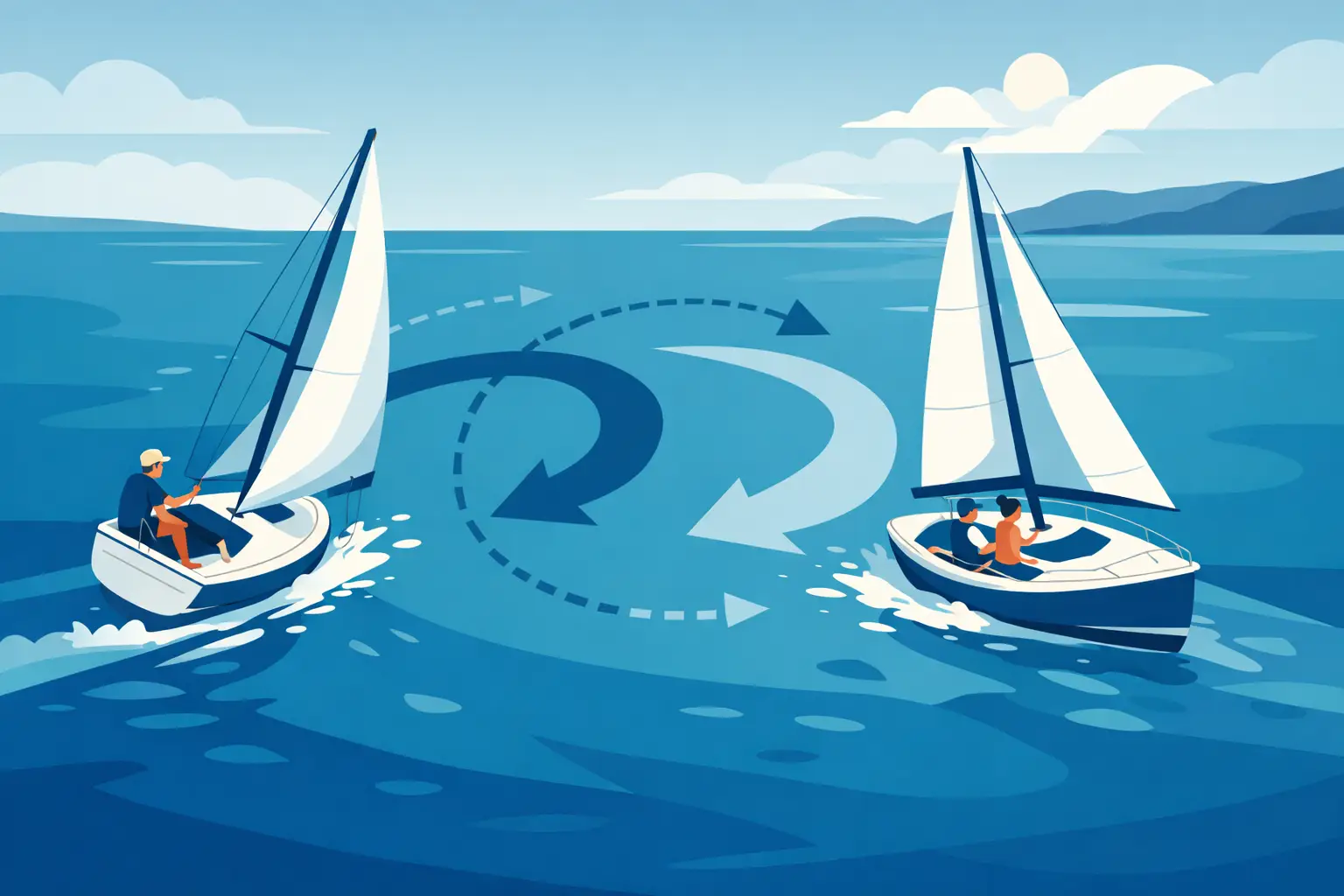
The boat loses pressure, the bow rises too high, and the sails begin to flap. That is the moment when the sailing maneuvers They cease to be technical terms and become decisions: stay on course, adjust the sails, or change tack. Those who understand the relationship between the wind, the rudder, and the sails don’t just turn the boat. They ensure that the maneuver preserves speed, balance, and control.
In sailing, almost nothing happens as a result of a single command. Turning the helm changes the course, but it also alters the angle of the wind relative to the sails. Trimming the sheet increases power on certain courses, but it can cause the hull to heel too much. Easing the sheet can stabilize the boat, as long as the sail isn’t left flapping. The good news is that this logic becomes clear when you observe cause and effect, repeating each movement until the boat responds as expected.
Before performing sailing maneuvers, read the wind
A maneuver begins before you touch the helm. Look at where the boat is heading, which side the wind is coming from, and which sail is working. If the wind is coming from the right, you’re sailing on starboard; if it’s coming from the left, you’re on port. That side determines which tack is catching the wind and helps you predict where the sails will cross.
The key point is the apparent wind: the wind that the crew member feels on board, which is the sum of the true wind and the boat’s movement. The further the sailboat moves forward, the more the apparent wind tends to come from ahead. For this reason, a trim setting that works when sailing broad reach may not work when you close-hauled to gain height.
Sailing directly into the wind is impossible for a conventional sailboat. If you point the bow too close to the wind, the sails lose lift and start to flap. It’s not a fault of the boat or a lack of skill at the helm. It’s physics telling you that, to sail into the wind, you need to zigzag, alternating tacks.
Commands that change the boat's behavior
point up is to point the bow into the wind. The boat gains height relative to the wind, but tends to slow down if you overdo it. To luff is to turn the bow away from the wind. Generally, the sailboat picks up speed, the sails need more slack, and the feeling of power increases.
The difference may seem small on the screen or on the helm, but it changes everything. To point up, mainsail and genoa Gradually, without closing the sail beyond the point where it begins to lose flow. When tacking, ease the sheets as the angle opens. A sail that is too tight on a broad reach creates drag, heel, and a boat that’s heavy to handle.
The helm also requires a gentle touch. A sudden turn slows the sailboat down because the hull begins to drag water sideways. Instead of turning the helm all the way, make small corrections, wait for the boat’s response, and use the sails to balance the direction. If the sailboat keeps heading upwind, the mainsail may be too full or the boat may be heeling too much. Before fighting the rudder, ease off the mainsail.
Hunting and relaxing are not automatic actions
Hooking the sail means bringing it closer to the center of the boat. Easing it means letting it fill out. The reference point isn’t a fixed position of the sheet, but rather the correct angle to the wind. In a gust, heaving to may seem like the natural reaction, but often the opposite is true: easing off the mainsail a little reduces pressure, lessens the heel, and restores steering control.
The genoa also plays a role in maintaining balance. If it’s set too close to the wind, it can pull the bow downwind. If the mainsail is too tight, it can cause the boat to point up. This interplay between the sails is one of the most interesting aspects of sailing: there is no single “perfect” setting; rather, there is a setting appropriate for the course, wind strength, and the objective of the maneuver.
Keep moving forward without stopping in the middle
A tack, also called a "cambada" at many clubs, occurs when the bow crosses the direction of the wind. You were sailing on one tack, close-hauled until you crossed the no-sailing zone and came out on the other tack. It is an essential maneuver for sailing upwind, round a windward buoy or choose the most favorable side of the lane.
Make your preparations quickly. If the boat is already moving slowly, don’t point it even further into the wind while waiting for the rudder to respond. Luff slightly, let the sails fill, stabilize the course, and only then begin to point up continuously. On a real boat, alert the crew, check that there are no nearby boats, and steer the bow into the wind without any sudden movements.
When the genoa loses pressure, it needs to cross over to the other side. Don’t let go of everything too soon. Keep the sail working until it starts to touch the forestay or lose wind, then release the old sheet and trim the new sheet rhythmically. The mainsail crosses on its own, but it must be adjusted so that the boat exits the gybe with sufficient power.
The classic mistake is to come out of the turn pointing too high. The sailboat crosses the wind, but the speed drops and the sails flutter again. After the bow has turned to the new tack, bear away a few degrees to regain speed. Once the boat picks up speed, gradually return to point up until you reach your desired course. Gaining speed first is almost always more important than trying to gain height right away.
Jibe: the maneuver that requires foresight
In a jibe, the stern crosses the direction of the wind. It occurs on downwind courses, when you’re sailing with the wind coming more from astern. The difference from a tack is crucial: during a jibe, the backstay can sweep across the boat with a lot of fclose-hauled, especially in strong winds or during a gust.
Before jibing, check your surroundings and prepare the mainsheet. Partially trimming the sail reduces the distance the backstay will have to cross. Steer the stern into the wind in a controlled manner and follow the sail’s transition without letting the boat heel too much. As soon as the mainsheet passes, ease it to the new course and adjust the genoa to the correct side.
In strong winds, the maneuver requires even more leeway. An unintended jibe can catch the crew off guard, throw the boat off balance, and cause damage. Therefore, on an actual sail, wear a life jacket, keep people away from the path of the backstay, and choose between jibing or taking a wider turn. Sometimes, a longer maneuver is the quickest decision because it prevents a loss of control.
Gusts, Heeling, and Recovery
A gust isn't just more wind. It can change the angle of the apparent wind, increase the pressure on the sails, and cause the boat to point up. If the hull heels too much, the rudder blade loses efficiency and the sailboat begins to skid. The initial response is usually to ease off the mainsheet, not to turn the wheel further.
Keep the crew’s weight on the windward side of a real boat, let the boat breathe, and only then resume trimming. With a more consistent wind, you’ll be able to hunt again. The idea is simple: speed without balance won’t last. A boat that’s slightly less loaded but with a light rudder sails cleaner and allows for better decisions.
It’s also worth practicing how to recover when something goes wrong. If you bear away and lose speed, luff until the sails fill. If the genoa is on the wrong side after a tack, don’t try to force it back into position with just your arm: ease off the pressure a little, coordinate the switch, and get back on course. If the boat is heeled over and running away, ease off before pushing harder. Each correction has a specific sequence.
Practice the maneuver, not just the route
In a regatta, a good maneuver is one that maintains speed and sets the boat up for the next move. At the start, a poorly timed turn can knock you off course. When approaching a mark, point up too early can leave room for someone coming in with more speed. In a multiplayer duel, a well-timed gust and a smooth turn at the right moment can decide a rematch.
That’s why a simulator offers value beyond just entertainment. On VelejAÍ, you can repeat a tack, test the effect of a gust, feel the rudder response, and compare settings without relying on a marina, your own boat, or wind conditions. Hit the virtual water, make mistakes without fear, and pay attention to what changes with each attempt.
On your next sail, choose a single goal: to come out of every tack with the sails full and the helm light. Once you’ve developed that reflex, maneuvers will no longer interrupt your course—they’ll become the most fun part of sailing.