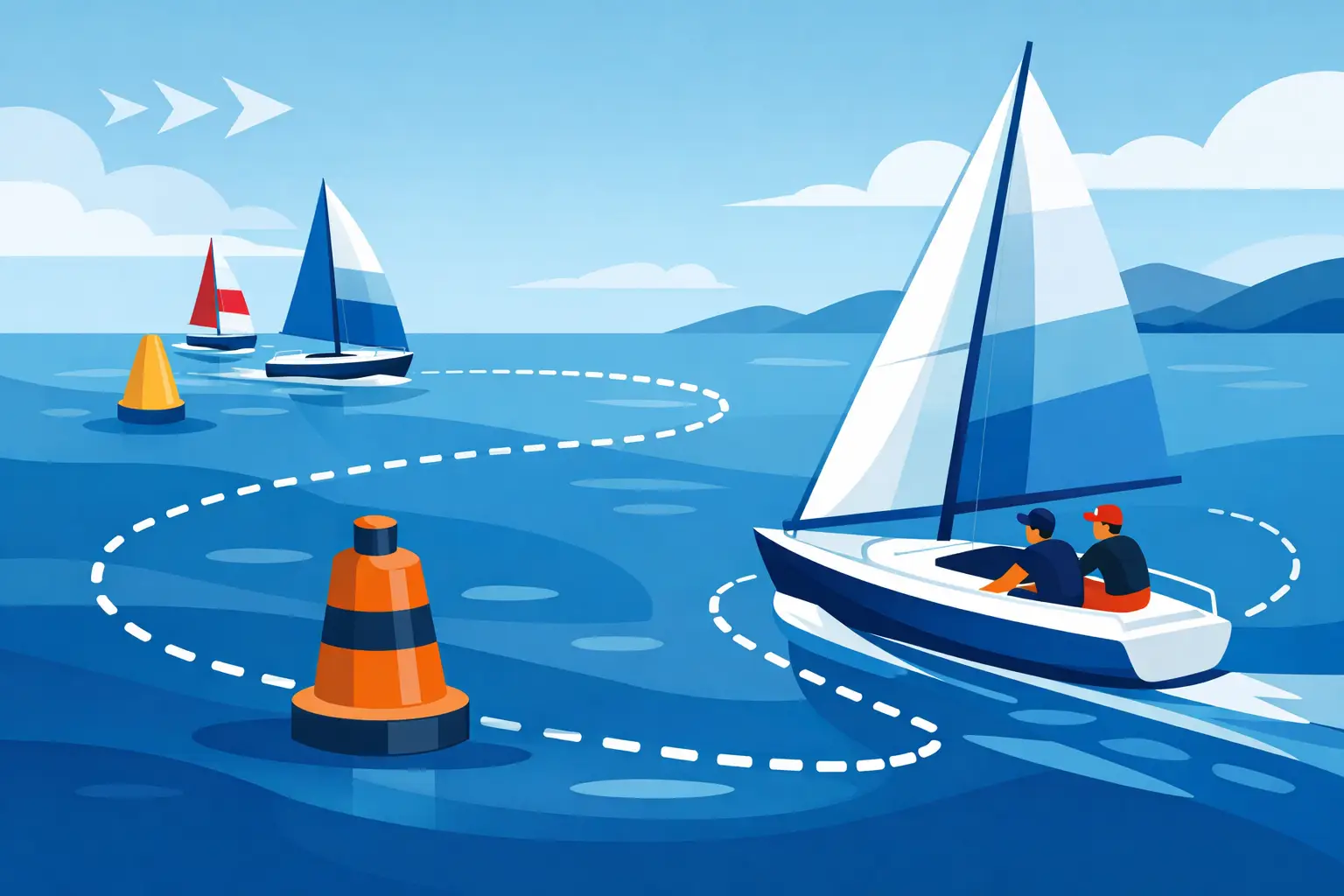
A regatta can turn on a dime: you get off to a good start, find clean wind, and seem to be in control of the fleet. Then a boat cuts across in front of you, steals your wind, and forces you to maneuver. That’s when the nautical tactics It ceases to be just theory and becomes a matter of making strategic decisions. It’s not enough to just sail the boat fast. You have to choose where to sail, when to change course, and how to use your opponents to your advantage.
The good news is that tactics aren’t a secret reserved for those who’ve spent years at a sailing club. They come from observation, simple decisions, and repetition. Adjust the sails, follow the wind, watch the course, and you’ll begin to understand why some boats move forward while others always seem stuck in traffic.
What is nautical tactics in practice?
Sailing tactics involve making decisions during a race based on the wind, the course, the rules of right-of-way, and the positions of other boats. They answer the most useful question of all: What is the next move that will allow me to gain ground right now?
That’s different from strategy. Strategy looks at the bigger picture: which side of the course tends to have more wind pressure? Where will there be a favorable current? Which side of the next leg offers a better approach to the mark? Tactics focus on the short term: should I cross this boat or pass astern of it? Can I tack without ending up in dead air? Is it worth attacking the mark on the inside, or should I preserve speed for the exit?
The two go hand in hand. You can choose the left side of the course correctly, but lose positions because you ended up in a line of boats with no wind. You can also make a brilliant maneuver to escape an opponent, but sail on the wrong side for too long. A good race requires a broad understanding of the situation combined with precise execution.
Start at the starting line, where strategy comes into play early on
The start isn't just about crossing the line at the right moment. It determines the quality of your wind and the space available for the first leg. A boat that starts late but has clean air and speed often has a better chance of making up ground than one that starts squeezed in the middle of the fleet.
Notice which end of the line has the advantage. If one end is closer to the leeward buoy, it tends to shorten the course. But be careful: this advantage usually attracts a lot of people. A favored and congested end can cost more than it’s worth, especially for those who are still working on their speed control.
Find some space to build up speed before taking the shot. Reach the line without moving It's like trying to climb a hill with the brakes on: the boat is slow to respond, the sail loses momentum, and your opponents take the lead. Keep enough distance from point up to build up speed and cross the finish line with the hull still on the water.
A tailwind is worth a few positions
After the start, don’t just keep your eyes on the buoy. Look at the sails of the boats ahead. When you’re sailing right behind and downwind of another sailboat, you get turbulent wind—with less fclose-hauled and an irregular direction. The effect is felt on the helm, the heel, and the speed.
Sometimes, the best move isn't to aim higher. It's to drop down a bit, get into a clean slipstream, pick up speed, and find an open section of the course. It may seem like you're giving up altitude, but you can make up for it many times over with consistent speed. The sail needs to be at the right angle to the wind, and it performs best when the wind hits it without the turbulence caused by another boat.
Read the wind shifts before tacking
On the windward leg, the classic question is when to tack. There’s no magic number of seconds. The answer depends on two things: is the wind on the leeward side or the windward side, and which side of the course do you want to reach?
When the wind shifts, it changes to a direction that allows you to point more toward the buoy on the side you’re on. If you notice that you’re luffing more without losing your general course, it’s worth holding the tack. When the wind drops, you’ll start heading less toward the buoy. In that case, tacking can put the boat at a more favorable angle.
Don't confuse a gust with a sustained shift. A gust increases wind intensity and may require immediate adjustment: flatten the sail, control the heel, and keep the helm light. A shift, on the other hand, changes the direction of the wind. Practice recognizing these by watching the apparent direction, the boat's heel, and its angle relative to the buoy.
Here’s a helpful rule of thumb: don’t turn just because your competitor did. First, ask what they’re trying to achieve. There might be more wind on that side, a shift in direction coming up, or simply a need to escape turbulent air. Copying without assessing the situation makes you a pawn in someone else’s decision.
Choose your lines with the track in mind, not just the buoy
The shortest leg on the map isn't always the fastest on the water. If the right side has more frequent gusts, or if there's a stretch with fewer boats, sailing a few extra meters can give you a real advantage. On the other hand, crossing the entire course unnecessarily is usually risky: you lose options and end up far from the next decision point.
Choose lines that keep your options open. Sailing near the middle of the course allows you to react to a roll, find pressure, or cross over to the opposite side if the conditions change. Getting boxed in on one side limits your options. There are exceptions, of course. If you’ve identified a clear wind or current advantage, committing to one side might be exactly the right move.
Also consider your position in the fleet. The sailor in the lead can mark the closest opponents, tracking their movements to defend their lead. Those at the back need to create some distance: seek clean wind, choose a less crowded side, or take advantage of a shift the leaders haven’t noticed yet. Covering too much ground when you need to make up ground means sailing to maintain your distance, not to close it.
Attack the buoy, leaving room to get away
Reaching the windward mark is a battle for position, but entering too tightly takes its toll on the exit. A boat approaching from the inside may be entitled to the necessary space, depending on the situation and the applicable rules, but it may round the mark slowly, with little wind and disorganized sails.
Before diving into the cake, think about the next leg. If the next one is at the stern, you'll want to get out of the buoy with the bow clear to accelerate and set the sails. Often, approaching a little more wide-open, rounding the mark with speed, and choosing a clean wind lane pays off more than gaining one position on the entry and losing three on the exit.
Knowing the racing rules is part of the strategy, not a bureaucratic detail. Knowing who has right of way at a crossing, what happens when approaching a mark, and when there is room to maneuver helps avoid penalties and reduces hesitation. Those who know the rules make decisions sooner. Those who don’t know them slow down, shout, or realize too late that they’ve given up their position.
At the stern, speed and pressure change the game
On the downwind leg, many beginners sail straight toward the buoy. However, the shortest route may not be the fastest. Sailing in a zigzag pattern, looking for an angle at which the sails work best, can increase speed and reduce the total time of the leg.
Use gusts to gain distance. When a gust hits, adjust the mainsail and the genoa to the new angle, keep the boat balanced, and take advantage of the opportunity to move sideways in the desired direction. When the wind dies down, avoid sudden movements that increase drag and destroy your momentum.
Keep an eye out for boats coming up from behind. At the stern, they can approach quickly and steal your wind. Don’t wait until you’re about to be overtaken to react. If there’s room, change sides, protect your pressure zone, and force your opponent to choose another route. Defending your position isn’t about closing the door any old way—it’s about preserving clean air without abandoning your efficient course.
Practice decision-making, not just maneuvers
Learning to turn, point up, and ease off is essential, but real progress comes when you connect the maneuver to a specific intention. During a training session, choose one focus at a time. Do a few starts to get a feel for when to accelerate. In another session, focus solely on the rolls. Then, sail a race and note how many times you lost speed by getting caught in choppy wind.
In a simulator like VelejAÍ, you can replay these situations without relying on a boat, a winch, club hours, or a perfect forecast. Make a start, make a mistake, go back, and try a different approach. Race against bots or invite friends for a live rematch. The physics of apparent wind, gusts, heeling, and trim quickly demonstrate the relationship between decision and outcome.
The best sailing tactic isn't a memorized sequence of maneuvers. It's the habit of looking ahead, reading the wind, and acting before the course closes. In your next race, choose a point to watch closely: a stretch of clear wind, a shift, or the mark rounding. Then trim the sails, make your decision, and watch the boat respond.