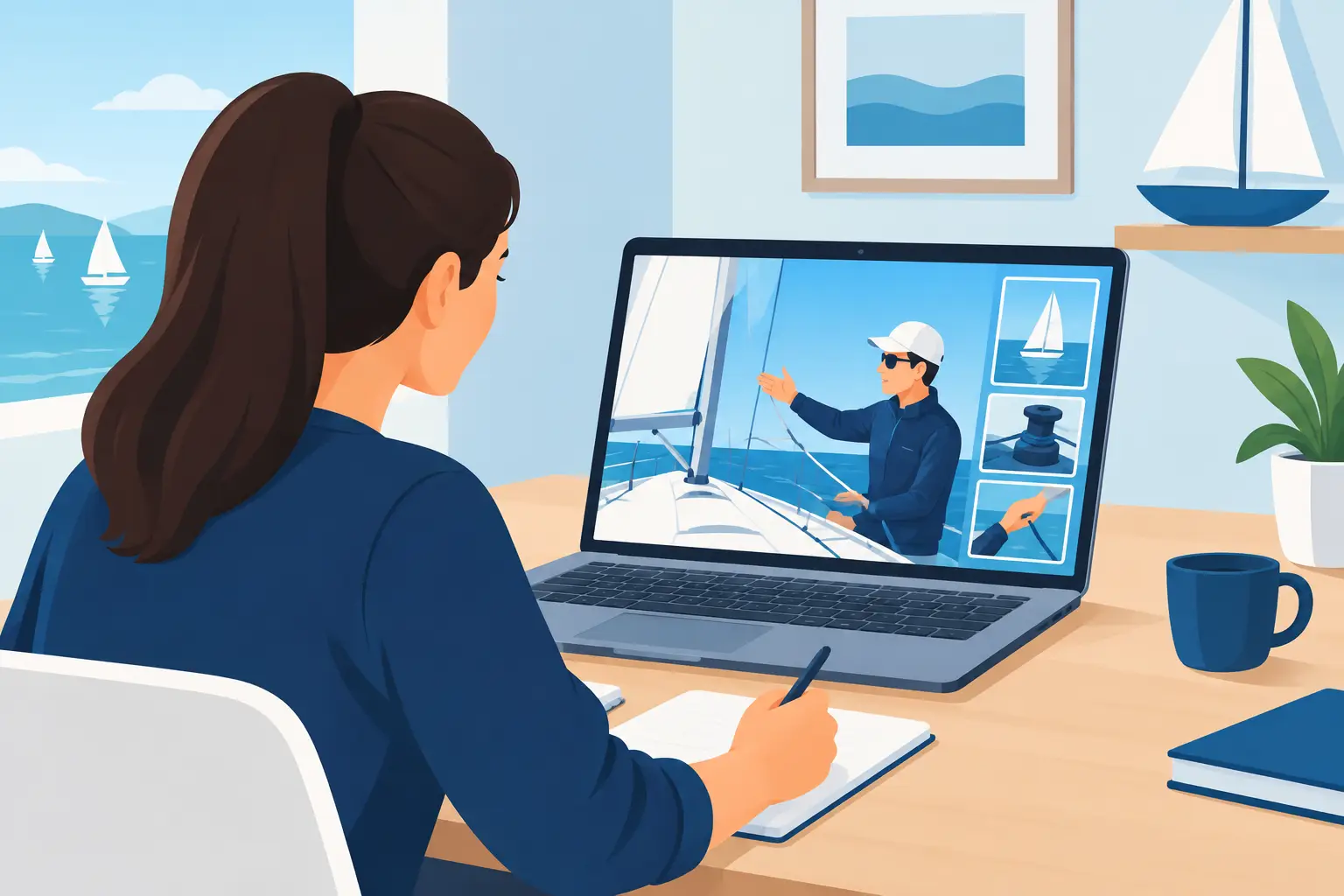
You don't need a boat, a yacht club or a whole free weekend to get a feel for the logic of sailing. In a beginner virtual training session, the boat responds to the wind, the sail asks to be trimmed and every decision shows up in the speed, the heading and the heel of the hull. It's a chance to learn by doing, without fear of making mistakes and without getting stuck in theory before your first maneuver.
From a distance, sailing looks simple: wind from behind, boat moving. In practice, it's a sport of angles, pressure and anticipation. Once you understand why the sailboat accelerates after an adjustment or loses power when it points too close to the wind, everything starts to make sense. Jump into the virtual water, try the controls and let the boat's response teach you the next step.
How to start beginner virtual training
The best start is not trying to win a race on your very first outing. First, watch the wind and hold a steady heading. In a sailing simulation, that reading is worth more than pressing controls at random: the boat moves well when the sail is at the right angle to the wind direction.
Start in open water, without the pressure of a race start. Point the boat in one direction and adjust the mainsail and the genoa little by little. If the sails are trimmed in too hard for that heading, the boat may heel too much and slow down. If they are eased too far, the wind slips past without generating enough power. Make one adjustment, wait for the reaction and compare the speed.
That cycle is the heart of learning: adjust, observe, correct. Good training doesn't depend on memorizing a table of trim settings. It depends on noticing cause and effect. The sail fills and the boat comes alive; the sail loses pressure and the speed drops. After a few laps, your eye starts looking for those signs naturally.
First, understand where the wind is coming from
In many simulators the wind has a direction and a strength, but it doesn't behave like a fixed arrow on the screen. When you change the boat's heading, you change the apparent wind - the wind you feel on board. That's why a sail that is well trimmed on one heading may need adjusting right after a turn.
Imagine the wind is coming over the side of the boat. If you speed up and change direction, the wind you perceive tends to move forward. The trim that worked before may now be too open or too tight. You don't need to work that out in your head at first. Just adopt one habit: whenever the heading changes, look at the sails again.
Gusts and wind shifts make this exercise even more interesting. A gust can make the boat take off, but it also increases the heel. A shift changes the wind direction slightly and calls for attention before the sail loses efficiency. Instead of fighting the boat, respond calmly: correct with the rudder and trim the sail to the new pressure.
Sail, rudder and heading: the trio that makes the boat go
The rudder is not an accelerator. Its job is to steer the hull, and using too much rudder creates drag. For beginners, this is one of the most common mistakes: noticing the boat drifting off course and making a sharp correction. The result is usually a string of zigzags, lost speed and trouble reading what the wind is doing.
Favor small corrections. Give it a nudge, wait for the bow to respond and bring the rudder back to a more neutral position. A sailboat needs room to glide. When you steer smoothly, it becomes easier to tell whether a loss of speed came from the heading, the trim or a change in the wind.
The sails, in turn, convert the wind into power. The mainsail is set on the mast and is usually your most direct reference. The genoa, at the bow, completes the sail plan and helps the boat gain power. On many headings they work together. If one is well trimmed and the other isn't, the boat can become unbalanced or leave speed on the water.
There is no single correct position for the sails. On a tighter heading, closer to the wind direction, they tend to work trimmed in harder. As you bear away and let the wind come more from the side or from behind, they can be eased. The rule of thumb for beginners is simple: trim the sail in until it starts working, and don't overdo it. Ease at the right moment and the boat takes off.
Learn to respect the no-sail zone
There is an area in the direction the wind is coming from where a sailboat cannot sail directly. Trying to point straight into it makes the sails lose pressure. When that happens, it's neither a flaw in the simulation nor a lack of skill: it's the physics of sailing.
The solution is to sail in a zigzag, alternating tacks. You climb against the wind in stages, tacking whenever you need to switch the sails to the other side. At first, practice this maneuver with no time target. Settle onto an upwind heading, keep your speed, tack with plenty of room and get the trim back on the new tack.
A tack is more than just turning the boat. Before it, the sailboat needs enough speed. As the bow passes through the wind, the sails switch sides and may lose pressure for a few moments. Then you steady the heading and trim again. Once that sequence becomes natural, racing stops feeling confusing.
A 20-minute session that really teaches
If you're short on time, a brief, deliberate session pays off more than sailing around aimlessly for an hour. Use the first five minutes to sail in a straight line on different headings. Sail with the wind on the beam, then bear away a little and, finally, come up toward close-hauled. Notice where the boat gains or loses speed.
In the next five minutes, practice trim. Keep the heading the same and change only the sails. Look for the point where they are full without seeming choked. Then do the opposite: keep the sails about the same and change only the heading. Separating the two helps you understand what each control does.
Use another five minutes to practice tacking. Don't rush. Go in with speed, steer the bow through the wind and regain the boat's balance on the other side. If the maneuver comes out slow or the boat stalls, try to identify why: was there too little speed before the turn, too much rudder, or were the sails out of trim?
In the last five minutes, place an imaginary mark on the screen and try to reach it without making unnecessary turns. This small challenge brings together wind reading, heading and trim. It's also a preview of racing logic: the winner isn't just whoever goes fastest, but whoever picks an efficient route.
When to enter an online regatta
You don't need to master every maneuver to race. In fact, competing early can speed up your learning, as long as the goal is to observe and improve. A start shows how position, timing and wind matter even before the boat reaches top speed.
Against bots, take the chance to test decisions without pressure. See whether it pays to start on one side of the course, compare your speed on each tack and notice how a poorly executed maneuver costs precious meters. In a live race with friends, training gets extra spice: every crossing demands attention, and every lead sets up a rematch.
On VelejAÍ, you can start in your browser, train freely and then join timed or multiplayer regattas. The point is not to pretend the screen replaces the whole experience of being on a real boat. It doesn't replace the motion of the water, the communication among the crew or the physical effort of a day's sailing. But it delivers something valuable: the background to understand what is happening when you trim, point up, ease or tack.
Common questions from beginners
Do I need to know nautical terms before training?
No. The terms help you talk about sailing precisely, but they make more sense once you've felt what each one does. First, notice that the mainsail affects balance, that the genoa helps generate power and that the rudder changes the heading. Little by little, the vocabulary stops being a barrier and becomes a tool.
Why does my boat turn too much or feel heavy?
There is probably too much pressure in the sails for the current heading, a gust has hit, or you are making large rudder corrections. Reduce the power in the sail a little, steer more smoothly and see whether the hull starts gliding again. Sometimes the best answer is not to turn more, but to ease a little.
Can I really learn to sail in a simulation?
You can develop wind reading, a sense of heading, an understanding of trim and race thinking. Practice on the water still has important particulars of its own, such as safety, tide, waves and onboard routine. Even so, arriving at an in-person lesson already understanding why the boat can't sail straight into the wind completely changes the experience.
The best first goal is not to sail a perfect race. It's to look at the boat, make an adjustment and be able to explain why it sped up or slowed down. When that conversation between wind, sail and hull starts to become clear, the urge to go around one more time comes by itself.