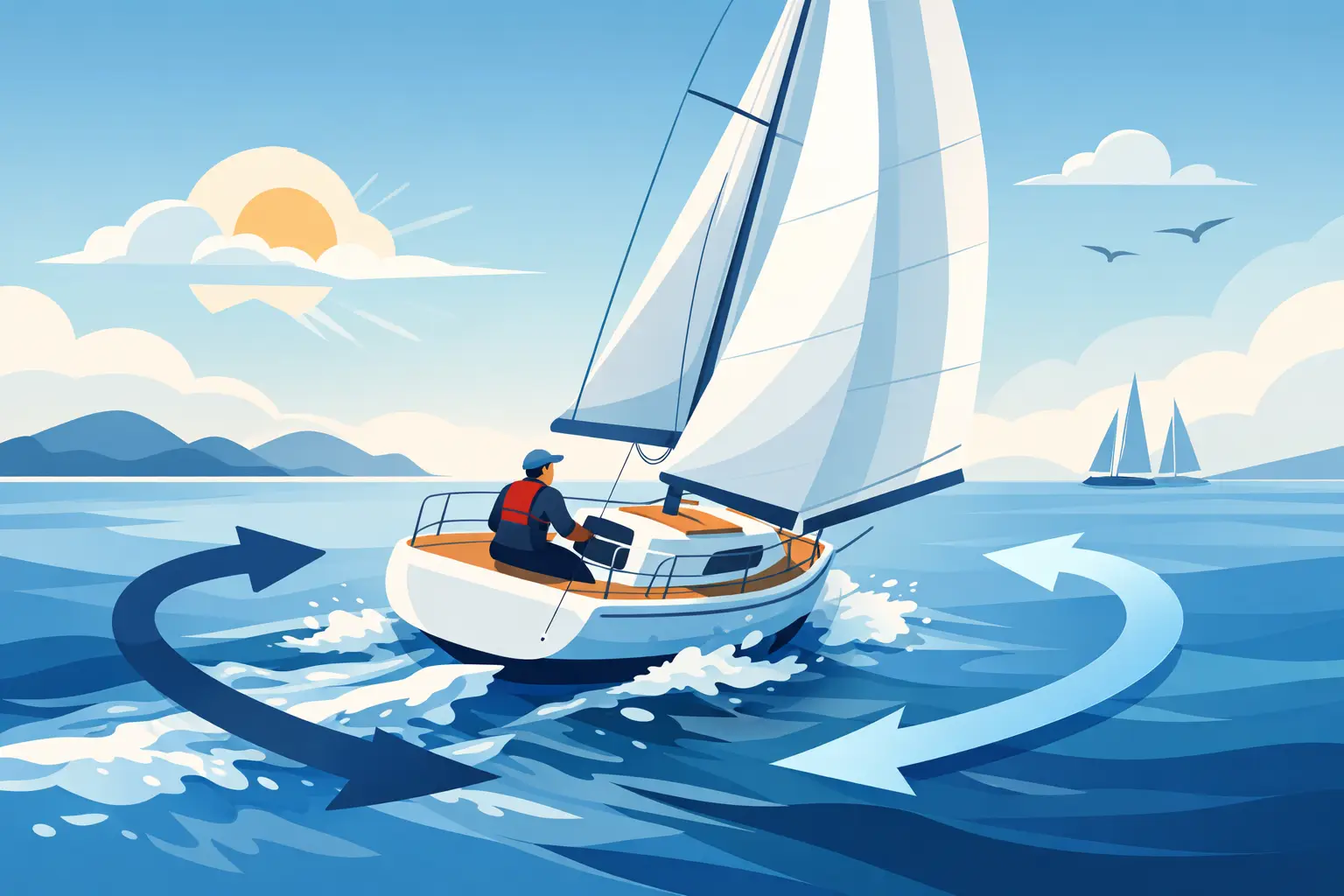
Tacking is the sailing maneuver in which the boat seems to defy the wind: you head as close as possible to where the wind is coming from, the sails fill out, and the hull comes alive. If you came here looking for How to sail close-hauled on a sailboat, let's start with a helpful clarification: in Portuguese nautical vocabulary, the most commonly used term is narrow. The principle, however, is simple and exciting: finding the balance between climbing into the wind and maintaining speed.
In practice, anyone who tries to aim too high to “gain height” ends up bringing the boat to a stop. Anyone who leans too far forward sails fast but covers a greater distance to the buoy. The ideal close-hauled course lies between these extremes. It is here that trim, steering, crew weight, and reading the gusts cease to be mere theory and translate into meters gained in the race.
What happens when a sailboat tacks?
In short, the apparent wind It hits the bow at a sharp angle. The sail does not act like a parachute pushing the boat forward. It creates lift, much like a wing, and converts part of the wind’s force into forward motion. The keel resists lateral heeling, and the rudder maintains the course. When these elements work together, the boat moves forward and climbs against the wind in a zigzag pattern, alternating tacks.
There is a physical limit to this. No sailboat can sail directly into the wind. Ahead of the bow is a dead zone, also called a no-sail zone. If you enter it, the sails begin to flap, and the boat loses pressure, speed, and control. Depending on the boat, the sails, the waves, and the wind strength, an efficient close-hauled course is usually around 35 to 50 degrees relative to the true wind.
Don't let that number become an obsession. The best angle is the one that keeps the boat with pressure on the sails, consistent speed, and a light rudder. In calm water and steady wind, it may be possible to point further. With short waves, light wind, or an unbalanced crew, dropping the angle by a few degrees can make the sailboat move forward much more efficiently.
How to Tie a Clove Hitch on a Sailboat, Step by Step
Stay on course without fighting the rudder
Start on a wider course, with the boat already picking up speed. Then, gradually bear away until you’re on a close-hauled course. Don’t turn the helm all at once to try to “climb” quickly. A sudden turn slows the hull, increases rudder drag, and can deprive the sails of sufficient airflow.
Watch the bow and the behavior of the headsail. As you approach the wind, the genoa or jib should be sheeted in, but still with a clean flow. If the leading edge of the sail starts to flap, you’ve gone too far or need to adjust the trim. Ease off the sheet slightly until it fills out again.
Tighten the bolts until all play is eliminated
When sailing close-hauled, the jib and genoa are set close to the boat’s centerline. The rule of thumb is simple: trim the sail until it stops flapping, but no further. An overly trimmed sail becomes too closed, creates drag, and can increase heel without gaining speed.
On a genoa, use the air streams when available. They need to run relatively parallel on both sides of the sail. If the inner stream rises or flutters before the outer one, the sail is too close to the wind or the boat is heading too high. If the outer filament loses flow first, there may be too much slack or the boat is heading too low. Make small corrections, one at a time, and wait for the boat to respond.
On the mainsail, pay attention to the leech and the boat’s heel. The sail should be trimmed tight to work effectively, but with enough twist at the top to relieve gusts. In stronger winds, flattening the mainsail too much can make the boat stiff and skittish. Sometimes, a slight gap restores control, reduces the rudder angle, and makes the sailboat accelerate.
Keep the boat balanced
A fast-hulled boat is not the same as a boat that heels excessively. When the hull heels too much, the keel loses efficiency, the rudder has to compensate, and the boat skids. You can feel this when the rudder becomes heavy and the boat keeps luffing on its own.
On a real sailboat, the crew must shift their weight to windward. In light winds, the adjustment is more delicate: too much weight on the outside can drag the stern and increase the wet area. In strong winds, keeping the boat flatter is usually an immediate source of speed and control.
In the simulator, this balance is evident in the rudder response, the heel, and the loss of speed when oversteering. Try sailing into a gust with the sails fully trimmed, and then try again by easing off the mainsheet slightly. The comparison makes it clear why control is more important than brute force.
Use the wind to decide when to aim and when to dive
The wind rarely stays the same for long. Gusts increase the pressure on the sails. Shifts change the direction of the wind and alter the course that seems to be the best close-hauled course. Those who simply set their course by a compass miss opportunities. Those who read the wind steer the boat—not just the course.
When a gust hits, your first instinct might be to luff up. This works if the boat is still balanced and gaining speed. But if it’s already heeled over too much, luffing up increases the load on the rudder and can slow you down. In that case, ease off the mainsheet a little or heel over a few degrees to pick up speed and regain stability.
On a downwind leg, when the wind is coming more from behind your course, you can point higher without entering the dead zone. On an upwind leg, bear away to maintain the flow in the sails. This constant adjustment is what distinguishes a mechanical close-hauled sail from an efficient one.
Height or speed? The answer changes during the race
Sailing high seems to be advantageous because it brings the boat closer to the windward mark. However, height without speed is an empty promise. A boat that sails lower but is faster can reach the same layline sooner and with more maneuvering options.
Near a buoy, height becomes important because it saves you from having to make two extra tacks. On a long leg, average speed and clean air are almost always more valuable. If there’s another boat ahead, don’t get stuck in dirty air just to keep the same heading. Make a tack, find clean air, and come back with the boat up to speed.
It also depends on the wind and the waves. In choppy water, leaning back a little to ride the waves with momentum may be the fastest option. In light winds, smooth movements and slightly looser sails help maintain momentum. In strong winds, controlling the heel and reducing sail area can ultimately allow you to maintain a better course.
Mistakes That Slow You Down on the Close-Hauled Leg
The most common mistake is to overreact and pull the tiller to windward. The boat may even seem to rise at first, but it soon stalls, heels over, and begins to skid. Another mistake is correcting every slight change in direction with large movements of the tiller. A fast sailboat responds best to small, anticipatory inputs.
It’s also a good idea to avoid focusing on just one reference point. Watch the bow, the heel, the feel of the helm, the wake, and the other boats. When all these signs indicate that the sailboat is clear and under pressure, you’ve found an efficient close-hauled course.
Finally, don’t treat each tack as an isolated maneuver. Before tacking, accelerate. During the tack, keep the boat moving smoothly. Then, adjust the sails immediately on the new tack. A slow tack or one where the sails take too long to fill gives away precious meters to those competing on the same leg.
Practice self-discipline by understanding cause and effect
The fastest way to learn is to repeat the same stretch under similar conditions and change just one variable. Make one run with the genoa tightly trimmed. On the next run, leave a little slack. Then repeat, changing the course by a few degrees. Compare the boat’s height, speed, and how easily you can keep it on an even keel.
On VelejAÍ, you can take this test right in your browser, without needing a marina, equipment, or a weather forecast. Join a free practice session, look for the windward leg, observe the apparent wind, and use the gusts as a signal to act. Then, apply what you’ve learned to a race against bots or Challenge your friends in a live match.
Tacking improves when you stop looking for that one perfect angle and start listening to the boat. A flapping sail calls for adjustment, a heavy rudder calls for balance, and a gust calls for a quick decision. Trim the sails, keep the hull lively, and fall into the virtual water until each tack starts to feel natural.